

An ancient grave may preserve more than bones. Alongside a person’s remains, which can yield their DNA, archaeologists may find ornaments, weapons, vessels—or no surviving goods at all. Could the objects buried with someone tell us something about their genome, and could the genome change how we read those objects? Might both offer clues to what that person did in life, or to the place they held among others? Figure 1 illustrates the contrast.
Figure 1. Two hypothetical burials, different grave furnishings
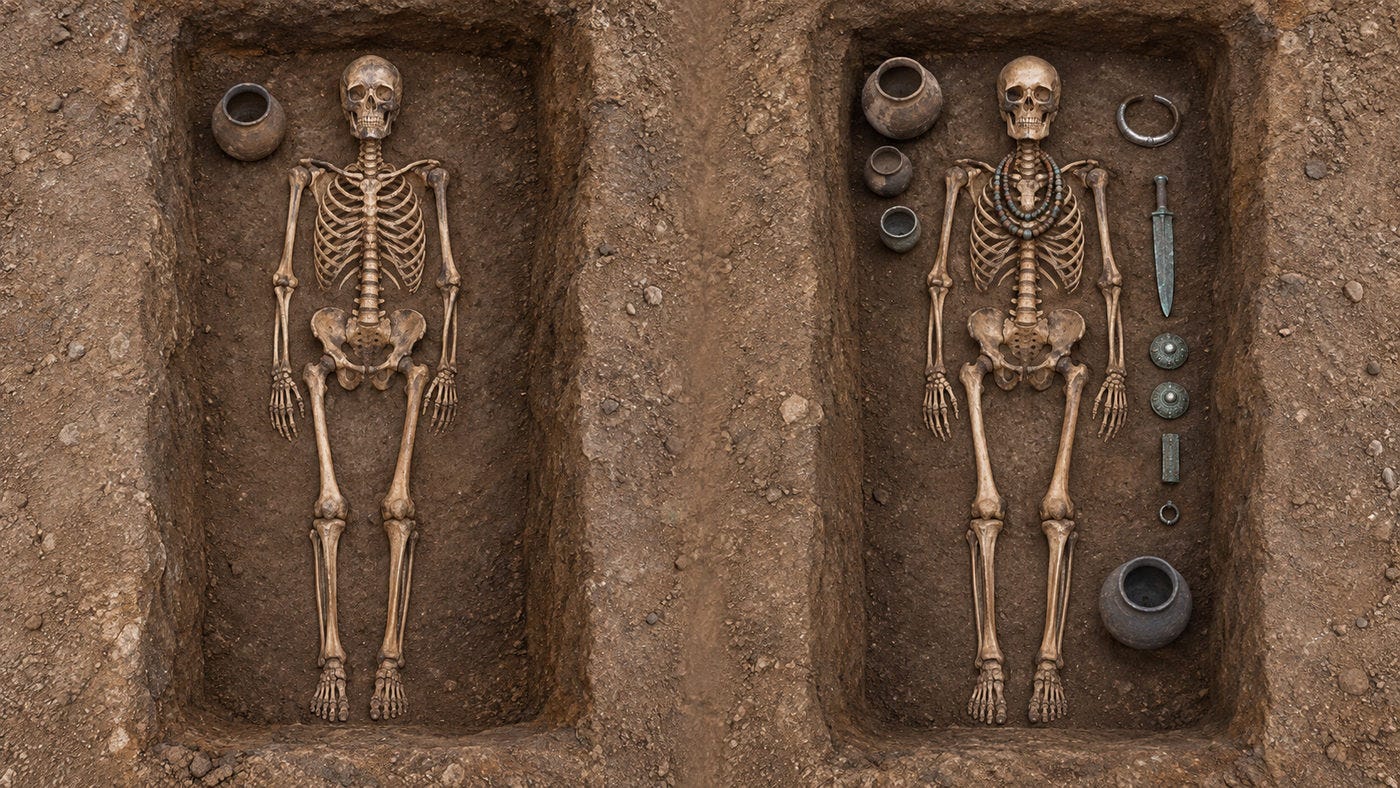
In my earlier essay, Was the Ancient Elite Tall, Blonde, and Light-Skinned?, I raised a hypothesis: genetic signals associated with lighter skin, higher educational attainment and social standing might have clustered in past populations. Higher-status people may have spent more time in sheltered work than outdoor labourers, exposing their descendants to different selection pressures; ancestry and marriage networks could also have shaped the pattern. A grave inventory offers a more direct observation with which to test part of it.
In earlier work, we traced scores for educational attainment, socioeconomic status and other traits through ancient European genomes. Akbari and colleagues studied how variants associated with modern traits changed through time in West Eurasia. These studies describe temporal genetic patterns. Interpreting those patterns as ancient education or social status assumes that relationships learned from modern genome-wide association studies carry over to very different populations and societies. Neither study checked an individual’s education score against an archaeological measure of that same person’s position.
There is a useful precedent for a physical trait: Marciniak and colleagues compared height scores with stature estimated from the long bones of the same 167 ancient people. For pigmentation, Ju and Mathieson traced skin-colour-associated variants through time, but could not check the original skin colour of those people directly. A skeleton leaves no comparable measure of years of schooling, income or test performance.
Modern evidence still gives a reason to test an education score against social outcomes. A separate income genome-wide association study found a 0.917 genetic correlation with educational attainment: the associated genetic signals overlapped strongly. An education-based score also explained an additional 4.7% of variation in occupational income in a modern validation sample. A study of occupational status found genetic correlations of 0.96–0.97 with educational attainment. These results come from modern cohorts; they do not show that the restricted ancient EA4 score predicts status in past societies.
This study tests that missing link. I compare each ancient person’s educational-attainment score (EA4) with the objects recorded in that person’s own grave. To my knowledge, this is the first cross-cemetery test pairing an ancient education score with the documented burial goods of those same individuals. Earlier ancient DNA work on Bronze Age Europe and Mokrin used kinship to investigate burial differences, but did not make this score-to-inventory comparison. Grave goods directly record burial treatment and can inform questions about social status.
