Did humans evolve to become morning people farther north?
Ancient DNA from western Eurasia challenges the idea of a persistent northward gradient in morningness

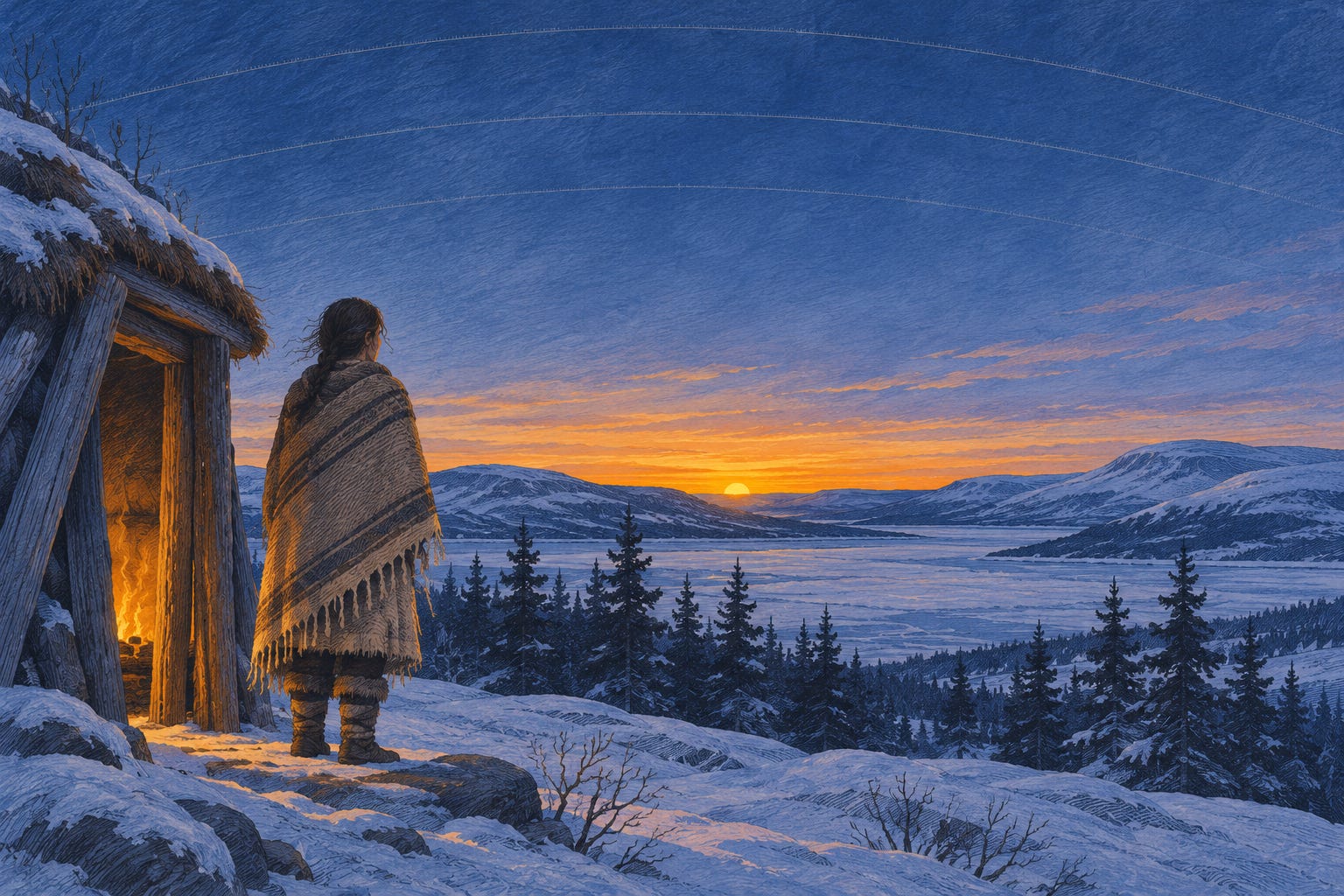
Winter days in Finland are far shorter than days near the equator. Could living with those seasonal swings have favoured people whose body clocks ran earlier? In a bioRxiv preprint, Shoko Hamamoto and colleagues argue that genetic variants associated with being a morning person became more common as modern humans expanded north, with a marked increase around 20°N. The paper is called Polygenic evolution towards a morning chronotype in modern humans. Read the preprint
I wanted to see what happened to the north–south difference in people who lived at different times. In dated ancient genomes from western Eurasia, I found little evidence of a persistent northward increase in morningness scores. Morningness scores rose slightly toward the present overall. The increase was faster at lower latitudes, weakening the fitted northward gradient over time.
The pattern in living populations
Chronotype is a person’s tendency to sleep and wake earlier or later. A polygenic score adds up genetic variants associated with a trait, giving more weight to variants with larger estimated effects. Here those weights came from a study of morning preference in living people. Applying those weights to ancient genomes tells us how much of that particular set of variants a person carried. Jones et al. 2019
Hamamoto and colleagues calculated scores for individuals in the 1000 Genomes Project as well as averages for 24 populations. Each population was assigned one approximate latitude. The authors reported a correlation of 0.58 between latitude and the score across populations. It rose to 0.90 after they excluded groups they considered to have migrated back to lower latitudes. Their ancient DNA came from five Neanderthals, whom they compared with living humans. They inferred the timing of the change in modern humans from the geography of living populations and their proposed migration routes. Read the preprint
In my reconstruction of the modern comparison, the correlation was 0.57 across the 24 population means and 0.37 when I pooled 2,344 individual scores. Averaging made the association stronger. Both calculations still draw their geographic information from the same 24 population latitudes. The 1000 Genomes Project
What dated human genomes show
I estimated change directly from dated ancient Homo sapiens genomes. Of the 12,447 individuals from western Eurasia, 4,042 came from a Nature study by Akbari and colleagues that assembled ancient genomes to study natural selection in the region (Akbari et al., 2026). Read the Nature study
I scored 321 variants and accounted for longitude, study, genotype uncertainty and broad genetic ancestry. A second model used a genetic relationship matrix (GRM) to account for relatedness.
The fitted score rose by 0.010 standard deviations per 1,000 years toward the present (95% confidence interval +0.0001 to +0.020, p = 0.049). With the GRM, the increase was 0.006 (95% interval −0.007 to +0.020, p = 0.35). With one latitude slope across all ages, the estimate was close to zero in both models. Per 10° north, it was −0.024 (95% interval −0.103 to +0.056, p = 0.56) and −0.011 with the GRM (95% interval −0.079 to +0.057, p = 0.75).
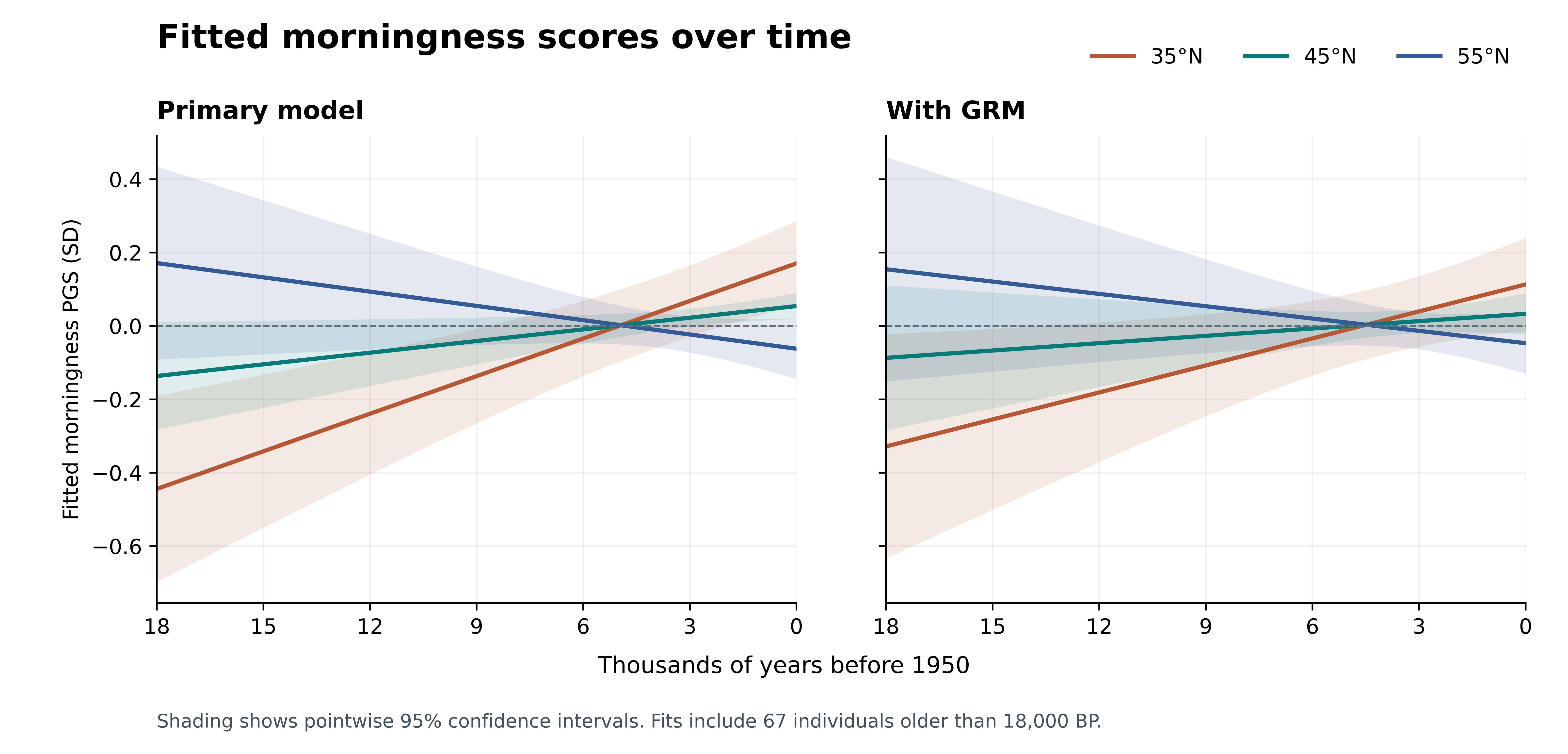
The increase was uneven. For each 10° farther north, the score rose 0.024 standard deviations less per millennium toward the present (95% interval 0.009 to 0.038, p = 0.0016). With the GRM, the difference was 0.018 (95% interval 0.002 to 0.034, p = 0.027). Figure 1 shows the fitted rise at 35°N and the much flatter trajectories farther north. At 55°N the point estimate is a decline, with uncertainty spanning zero.
Figure 1. Fitted morningness scores at 35°, 45° and 55°N
What the dated genomes can tell us
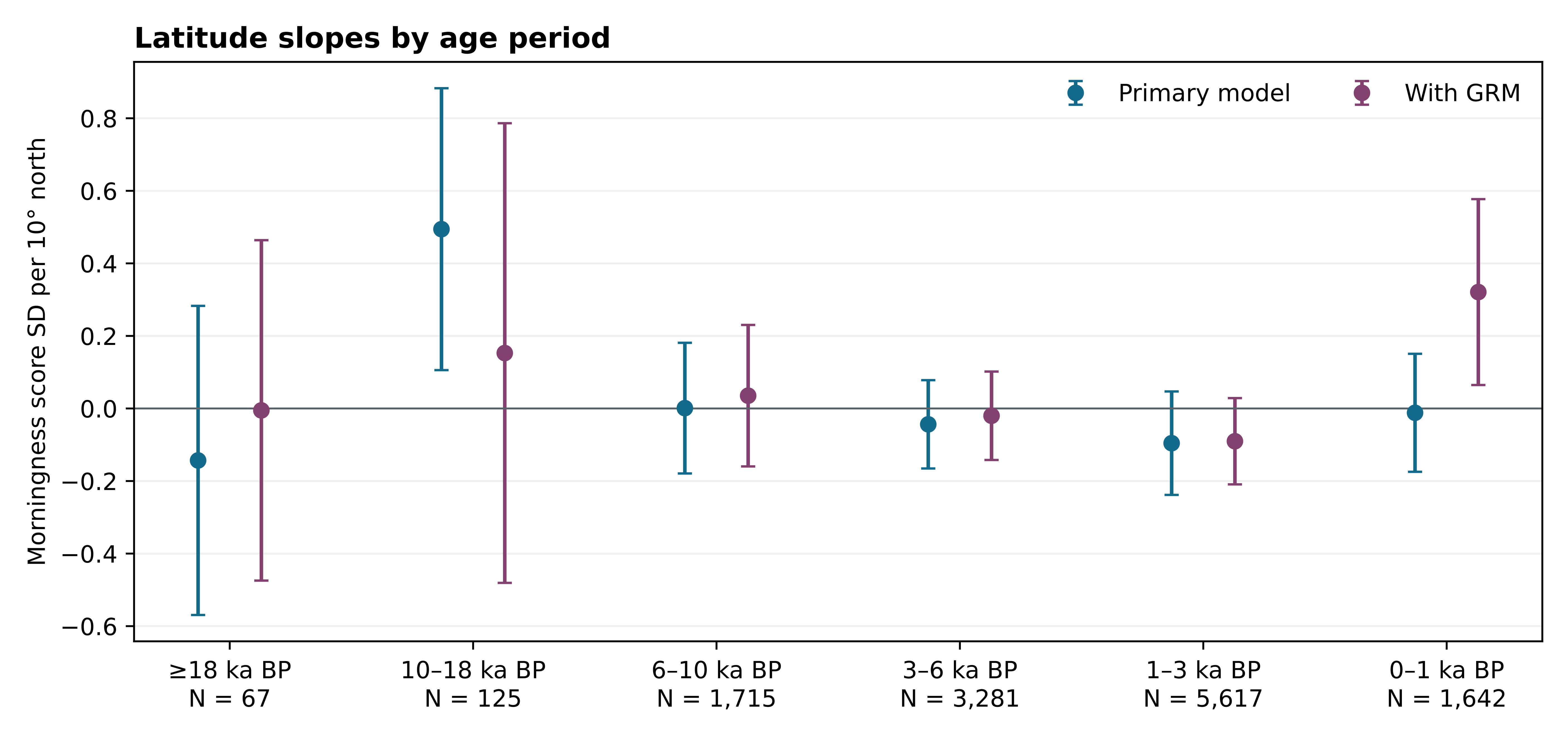
The lines in Figure 1 cross at roughly 5,000 years before present. That date comes from fitting a straight time trend at each latitude. I also fitted each period separately to see whether the observations supported a clean reversal. Figure 2 shows why the date is uncertain. The estimates are positive at 10,000–18,000 years before present, but that bin has only 125 individuals and its interval widens when relatedness is included. In the most recent millennium, the primary estimate is close to zero and the estimate with relatedness is positive.
Figure 2. The northward slope in each age period
The preprint’s 20°N boundary came from grouping present-day populations into 10-degree bands. The authors saw a rise across that boundary and proposed seasonal daylight near the Tropic of Cancer as a possible explanation. Only 39 of the ancient individuals in my analysis lived south of 20°N, all from one study in the Socotra archipelago. Excluding them leaves the latitude estimate near zero and the time interaction almost unchanged. A direct test of a step across 20°N would need dated samples from more places on both sides. Read the preprint
The ancient data give little support to the idea that higher latitudes consistently favoured a higher morningness score across the periods we can observe in western Eurasia. The first expansion across 20°N remains a separate question.
Methods and sources
The cohort combines 8,405 individuals from the Hybrid ancient DNA reference with 4,042 from Akbari and colleagues. Dates span 50 to 44,255 years before 1950. About 98.5% of the individuals are from the past 10,000 years. Site coordinates come from the source records. The analyses above 20°N use 12,408 individuals. Akbari et al. 2026
I reconstructed the 332 lead variants using the published filters. The ancient score uses 321 after dropping two absent from Akbari and nine with ambiguous allele orientation. I multiplied each effect weight by its expected allele count from the genotype probabilities and standardised the scores over the full ancient cohort. A sensitivity using 330 variants and the published orientation of those nine gave the same direction of interaction. Jones et al. 2019
The primary regressions include study fixed effects, longitude, age, five ancestry principal components and imputation variance standardised within study. Uncertainty is clustered by study. The interaction is the product of continuous latitude and years before 1950. Figure 1 shows adjusted means with study intercepts weighted by sample counts and other covariates held at cohort means. The relatedness sensitivity uses a genetic relationship matrix built from 4,072 markers away from the morningness loci.
The two primary tests are the constant latitude slope and the latitude-by-age interaction. The interaction has a Holm-adjusted p-value of 0.0031. It remains in the same direction when restricting to Europe, samples with reported coverage above 0.1×, and the past 10,000 years. The separate period fits allow each bin its own slope and controls. A joint test of whether those slopes differ gives p = 0.0027 in the primary model and p = 0.616 in the model with relatedness and shared variance parameters. The scores use genetic associations measured in living people, so their historical interpretation is limited to this particular set of variants.
Hamamoto, S., Moriya, Y., Fujito, N. T., Higuchi, S., Teshima, K. M., & Hayakawa, T. (2026). Polygenic evolution towards a morning chronotype in modern humans. bioRxiv. Read the preprint
Jones, S. E., Lane, J. M., Wood, A. R., et al. (2019). Genome-wide association analyses of chronotype in 697,828 individuals provides insights into circadian rhythms. Nature Communications, 10, 343. Article
Akbari, A., Perry, A., Barton, A.R. et al. (2026). Ancient DNA reveals pervasive directional selection across West Eurasia. Nature. Article
The 1000 Genomes Project Consortium. (2015). A global reference for human genetic variation. Nature, 526, 68-74. Article
Discussion about this post