

The people who crossed the North Sea after Roman rule helped create a new language and a new population in Britain. Their descendants lived alongside the descendants of ancient Britons, and over the following centuries those communities became part of the English population. I wanted to know whether that turnover also changed the genetic variants associated with height, hair colour, skin pigmentation and cognitive traits.
In Celtic and Germanic ancestry through time in Britain, I followed the population shift from Iron Age Britons to Anglo-Saxon cemeteries and medieval England. Here I present my original analysis of polygenic scores in those genomes, using Celtic- and Germanic-associated reference groups drawn from the two new Nature studies, Tracing the spread of Celtic languages using ancient genomics and Tracing the spread of Germanic languages using ancient genomics.
A polygenic score adds genetic variants weighted by their associations in modern studies. I use these scores to investigate inherited differences, while keeping them in genetic-score units: nutrition, disease and social conditions also shaped the lives and appearances of the people buried in these cemeteries. The question is whether physical and cognitive scores followed the same history.
The physical profile of the early medieval samples
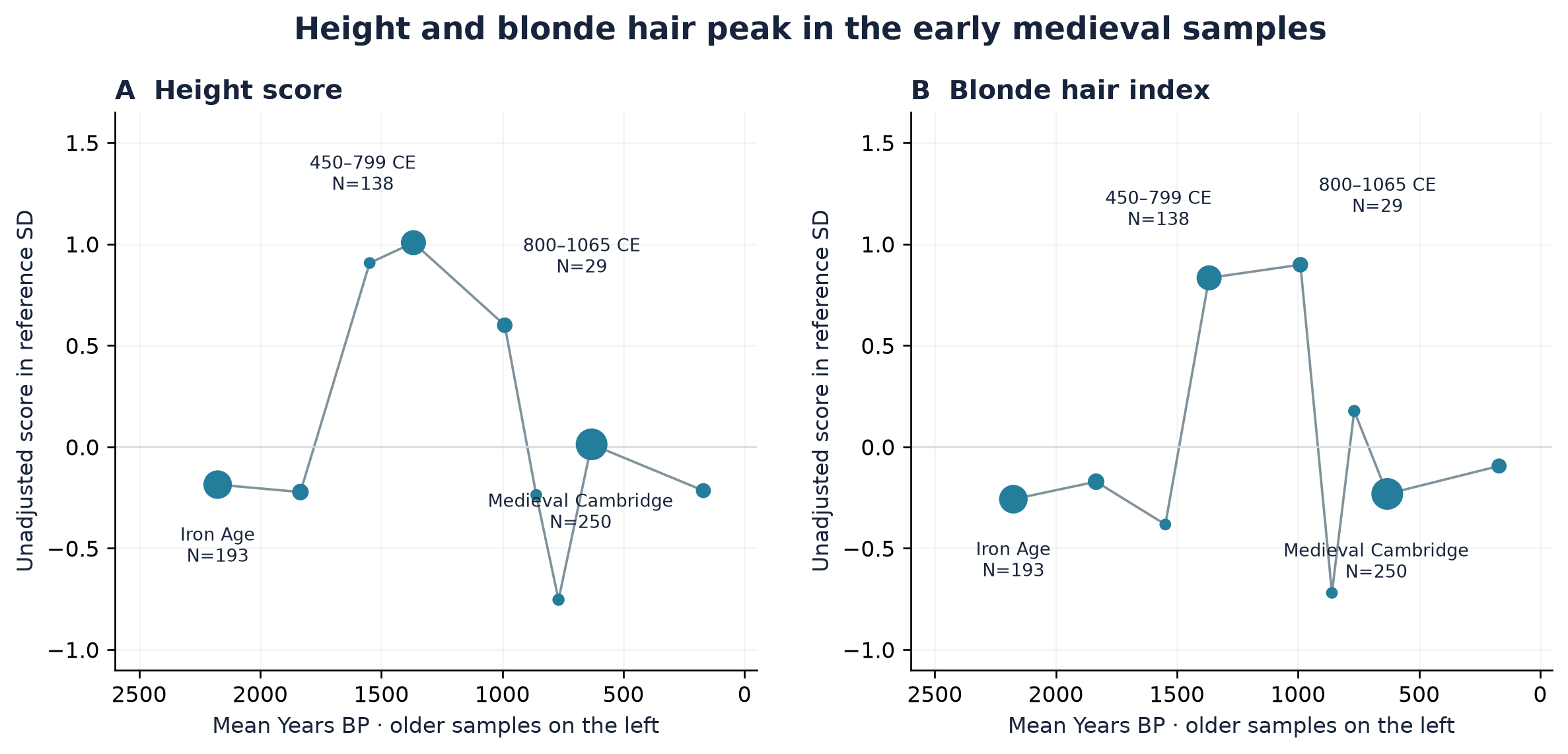
Figure 1 shows the first result. The 450–799 CE sample averages 1.19 reference standard deviations above the Iron Age sample for the height score and 1.09 above it for the blonde-hair index. Both are also high in the Viking-associated sample. Later medieval Cambridge has lower means, especially for blonde hair. Those are the actual period averages, before regression adjustments (Tables S4A and S4C in the supplement).
The chronology fits the arrival of people from the North Sea zone and their later mixture with the population already in Britain. The early medieval burials also represent particular communities: the 800–1065 CE pool is dominated by the Oxford and Dorset Viking-associated burials. The rise in the sampled means is a clear observation; identifying a migration effect requires comparing people at similar dates and allowing for the studies that produced their genomes.
Figure 1. Height and blonde hair scores across the English periods
Upgrade to paid to see whether the height and blonde-hair contrasts hold after adjustment, how medieval Irish and Anglo-Saxon burials compare on two height scores, how hair and skin scores changed through time, and whether cognitive scores differed between the ancestries. The supplement gives the full results for the English time series and ancestry comparisons.