

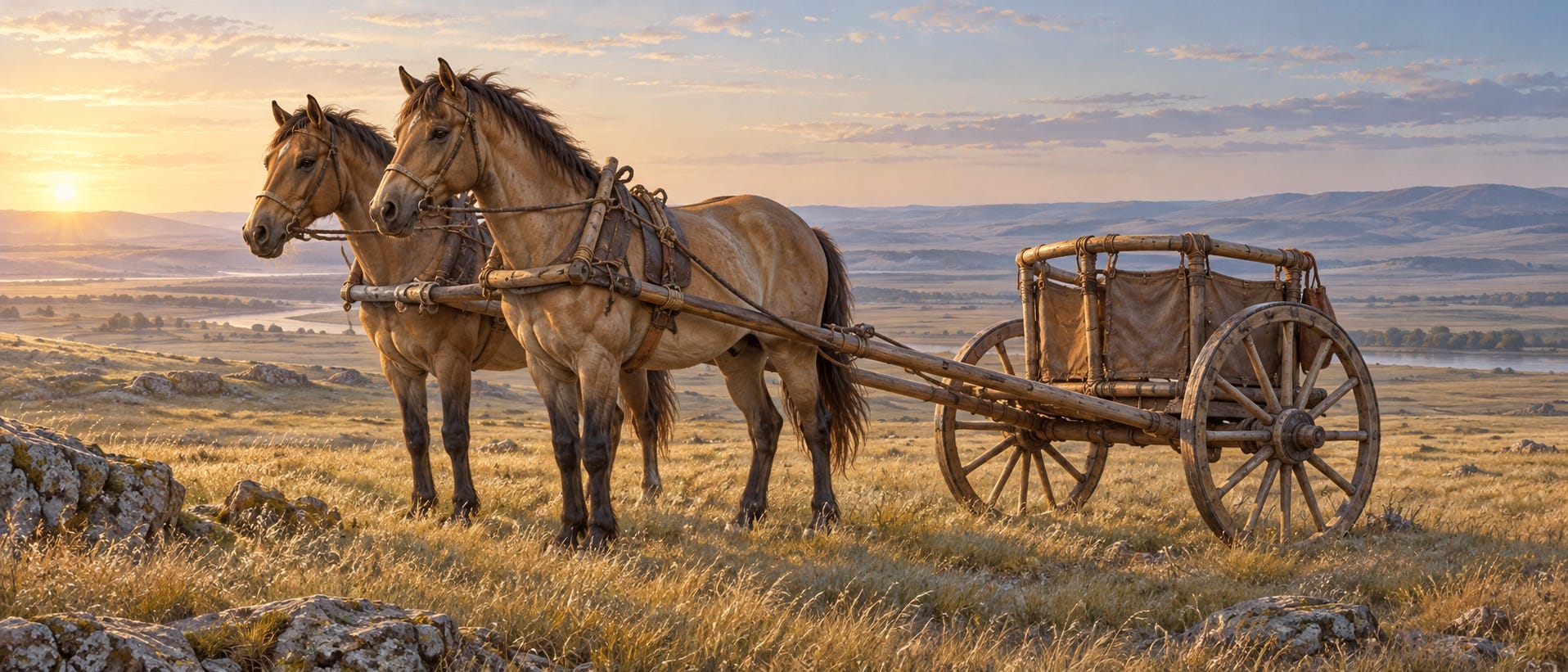
Plate 1. Chariot on the Eurasian steppe
The Bronze Age steppe migrations remade Europe. Around five thousand years ago, people related to the Yamnaya herders of the grasslands north of the Black and Caspian seas spread westward, bringing ancestry that became a major part of the European gene pool. The scale was enormous: Haak and colleagues estimated that the sampled Corded Ware people in Germany derived roughly 75% of their ancestry from a Yamnaya-related population.
Farther west, Olalde and colleagues found that the later Beaker-associated migration replaced about 90% of Britain’s gene pool within a few hundred years. Those migrants already carried a mixture of steppe and European farmer ancestry. It was a profound population turnover, even though the newcomers were themselves the product of earlier mixing.
We usually follow this story west, into Europe, or south towards India and Iran. But another part runs east, into the mountain valleys and deserts of what is now western China. Long before the Silk Road, Afanasievo-related people had brought Yamnaya-like ancestry into northern Xinjiang. Later arrivals introduced a different steppe profile, related to Sintashta and Andronovo.
“Western steppe herders” is the broader genetic category. “Aryan-related” here refers more specifically to that later Sintashta/Andronovo ancestry associated with Indo-Iranian dispersals. It connects to the larger steppe expansion through shared ancestry and subsequent mixing. Keeping those layers distinct lets us follow the eastern story without treating every steppe migrant as the same people.
I brought together 370 ancient Xinjiang genomes to follow both sides of this story: the arrival of steppe ancestry and its later loss of ground as East Asian ancestry increased. The sharpest later shift comes after the Iron Age. Comparing people buried at the same sites gives us a way to measure the change without confusing a later date with a different valley.
Two journeys east
There were two different steppe connections, separated by roughly a millennium. That distinction matters from the beginning: the first people to bring substantial steppe ancestry into northern Xinjiang were Afanasievo-related, while the later Andronovo connection belongs to a different expansion.
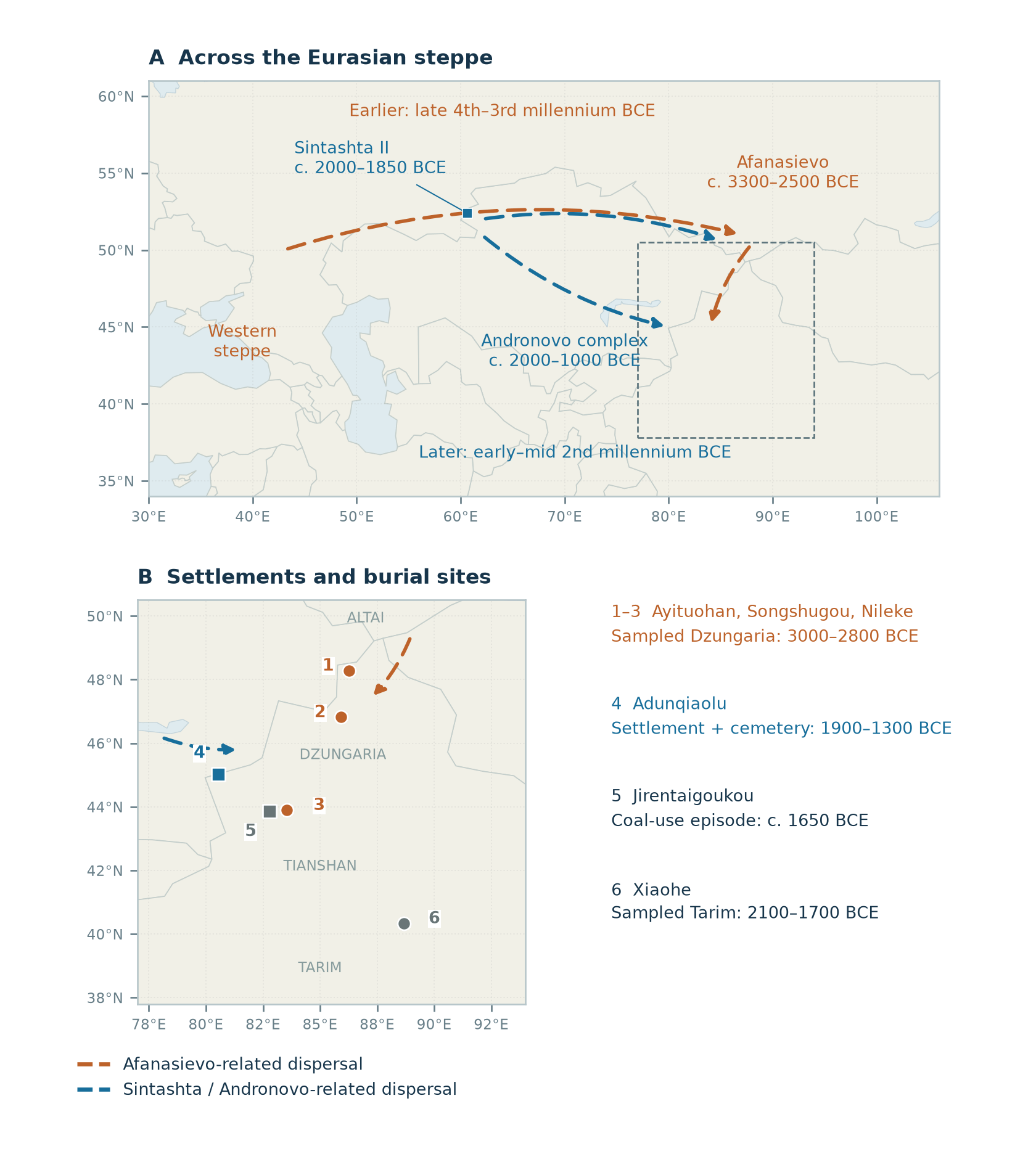
Zhang and colleagues (2021) found predominantly Afanasievo-related ancestry in northern Xinjiang individuals dating to about 3000–2800 BCE. These people were closely connected to the earlier Yamnaya-like expansion across the steppe. A possible link with the ancestors of Tocharian places them in another branch of the Indo-European story.
The later arrivals were genetically closer to Sintashta and Andronovo. They shared much of the older steppe ancestry, alongside an additional contribution related to European farmers, as shown by Allentoft et al. (2015) and Narasimhan et al. (2019). The DNA measures genetic relationships; identifying the languages these people spoke also requires historical evidence.
By the Late Bronze Age, Kumar and colleagues (2022) found individuals in Xinjiang with strong Andronovo/Sintashta-related affinities. Archaeology gives the movement a more tangible setting. Adunqiaolu, near the western edge of Xinjiang, has an Andronovo-affiliated settlement and cemetery, with dated contexts extending approximately from 1900 to 1300 BCE. Figure 1 places these connections alongside the earlier expansion.
Figure 1. Two steppe expansions into western China
The mummies complicate the story
The famous Tarim mummies might seem to offer a simple continuation of those migrations. Their genomes tell a different story. The earliest sampled Tarim individuals, dating to about 2100–1700 BCE, carried a deeply rooted local genetic profile. Zhang et al. distinguished them from the Afanasievo-related people farther north. Xinjiang already contained very different populations before the later steppe arrivals.
That regional diversity continued into the Iron Age. Kumar and colleagues identified Saka-related individuals and proposed a connection with the introduction of Khotanese, an Iranian language. Yang and colleagues’ 2026 study then drew a sharper east–west distinction: Andronovo-related ancestry in the western Tianshan, with Afanasievo-related ancestry persisting in eastern groups.
The published models make the contrast visible. In three selected western Iron Age models, the direct Andronovo coefficients are 56.2% at Balesa and 60.5% and 59.5% in two Nileke groups. The full period maps, with Andronovo and Afanasievo coloured separately, are in Figures 6A–6E below. These are published model coefficients with different source sets, so they should be read as a regional comparison rather than a single ancestry curve.
Upgrade to see where the Andronovo connection strengthened and what changed after the Iron Age, with the maps and full results from 370 ancient Xinjiang genomes.
