

Iosif Lazaridis’s Battles of the Romans is an unusually valuable contribution: it turns a vast span of military history into a catalogue that readers can inspect, question and analyse. Its 1,709 entries make it possible to move beyond a handful of famous battles. My earlier analysis examined the rising frequency of recorded Roman defeats. Here I ask a different question: after losing battles, did Rome recover more successfully than its opponents?
The stereotype has a powerful example. Hannibal destroyed a Roman army at Cannae in 216 BCE, yet Rome continued the war and obtained a victorious peace in 201 BCE. That is a remarkable recovery. Polybius describes the disaster and, later, the terms imposed on Carthage. But a famous example cannot tell us how common such recoveries were, or whether Rome’s enemies were less capable of them.
Polybius himself offers an explanation for this resilience. In Histories 6.51–52, he links Rome’s recovery from reverses to the quality of its political decisions and its reliance on citizens and allies. In his account of Cannae’s aftermath (3.118), the Senate encourages the population, strengthens the city’s defences and plans its response despite the catastrophe. These passages give the stereotype direct support in an ancient source, although they remain the interpretation of a historian who admired Rome.
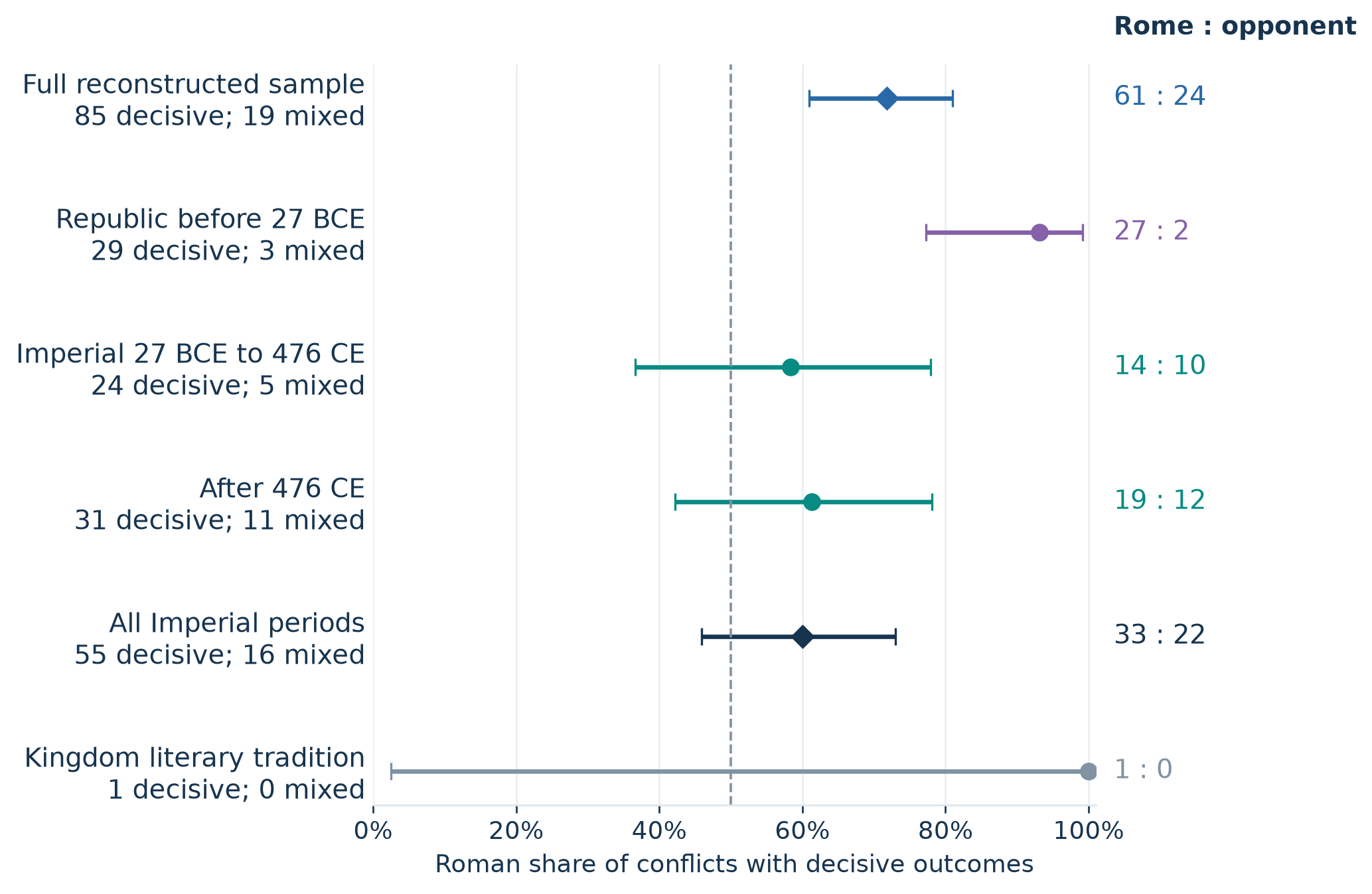
Across 104 conflicts in which both sides suffered a recorded defeat, Rome eventually secured a favourable ending in 61, against 24 for its opponents; another 19 had mixed outcomes. That is an impressive record of recovery, especially under the Republic. The surprise is that the later rise in battlefield defeats does not come with a clear decline in recovery throughout the Imperial centuries. Who Rome fought, however, makes the comparison harder than it first appears.
What counts as recovery
I count a recovery when a side suffers a recorded battlefield defeat and subsequently reaches a favourable ending to the reconstructed conflict. The ending must have independent support: a settlement, capitulation, political transfer, withdrawal or clearly terminated campaign. A final battle in a list cannot by itself establish how a war ended. Some units are bounded campaigns within longer struggles, so “conflict” is the more accurate collective term.
The main comparison requires a recorded defeat on each side. That puts Rome and its opponent or opposing coalition in the same conflict and gives each conflict one vote. It avoids allowing a well documented war with dozens of battles to outweigh many shorter ones. It also selects a particular kind of conflict: those in which the catalogue records setbacks for both sides. Figure 1 follows both sides from their recorded defeats to the same conflict ending.
Figure 1 How recovery after defeat is counted
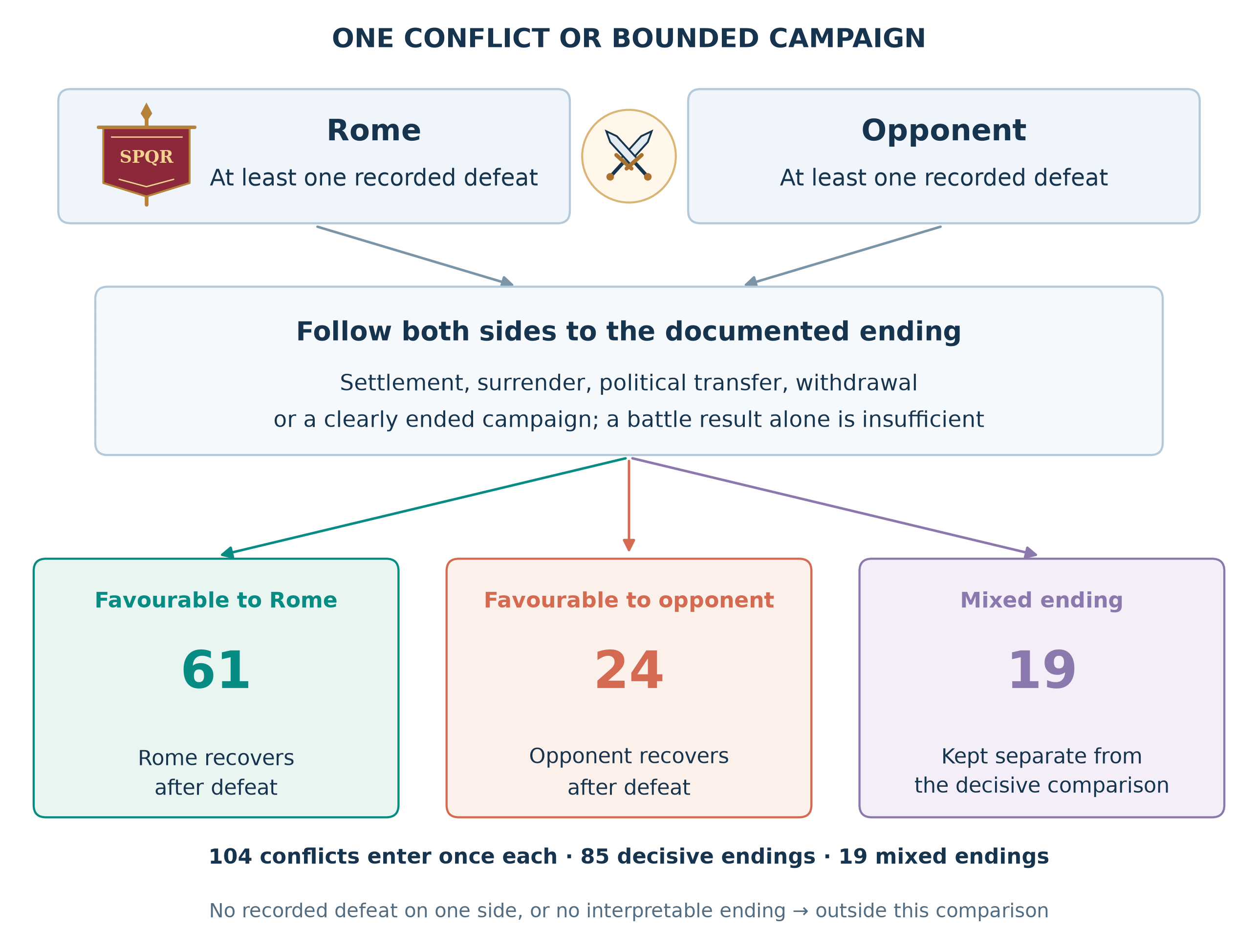
The sources allow 1,260 battle records to be grouped into 352 conflicts and campaigns with identifiable beginnings and endings. Of these, 104 contain a recorded defeat on each side, covering 816 catalogue entries. These are the conflicts in Table 1 and Figure 2. The Kingdom contributes just one case, drawn from later literary tradition rather than a secure contemporary record; it cannot establish a reliable recovery rate for Rome’s earliest centuries.
Table 1 Outcomes after each side suffered a recorded defeat
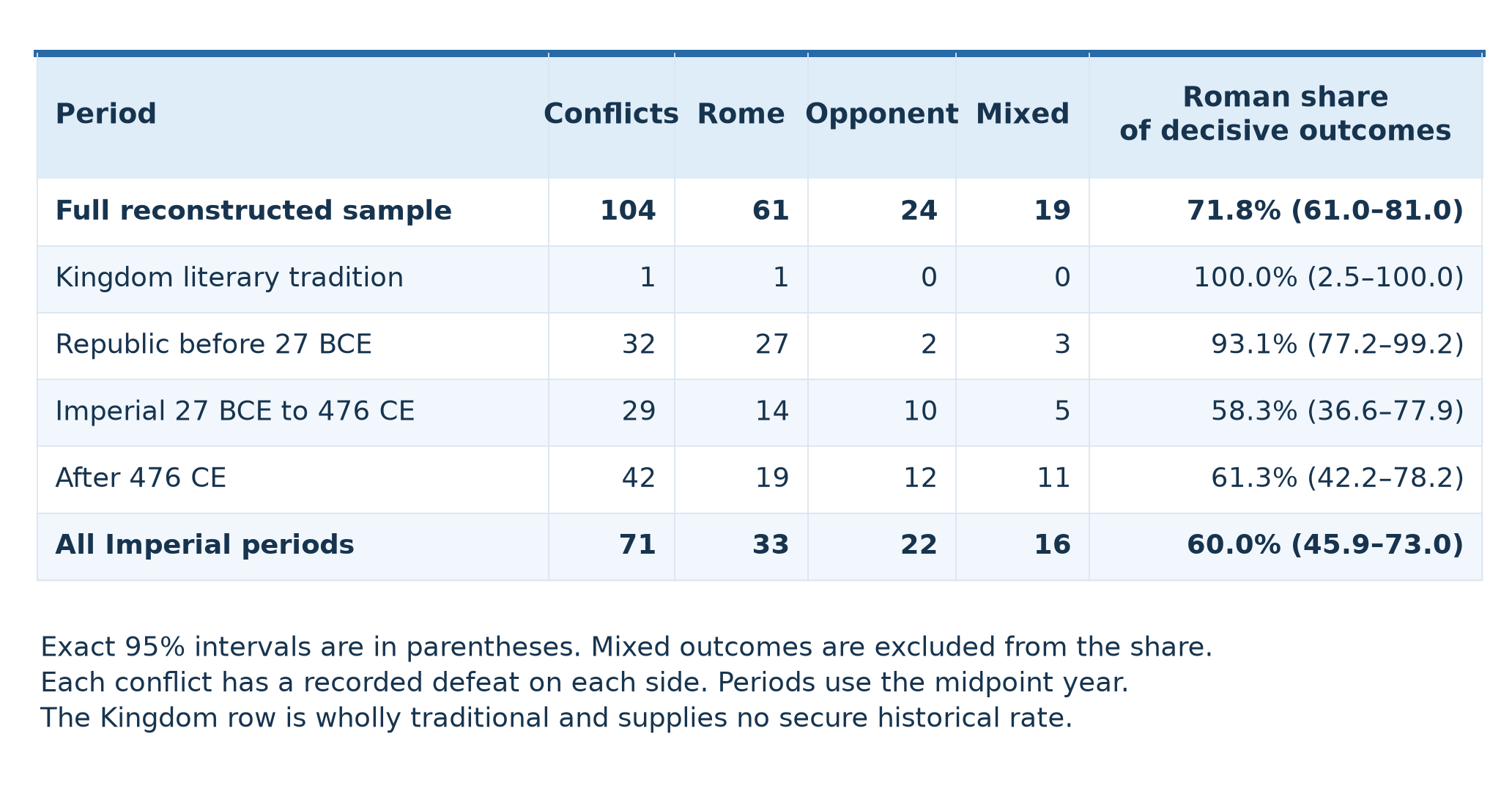
Figure 2 Roman recovery shares across historical periods
Upgrade to see how Rome’s ability to recover changed over time, whether the Republic’s advantage holds up against comparable opponents, and which side was more likely to fight on after a defeat.