Reich’s new paper: Could humans interbreed after 1.2 million years apart?
David Reich proposes an ancient mixture that raises questions about attraction and reproductive compatibility

Could two human lineages spend more than a million years apart and still produce descendants together'?
David Reich’s new preprint, Hypothesis: A modern human range expansion ~300,000 years ago had a critical role in Neandertal origins, proposes a history in which a successful early human population expanded into Europe and Africa, mixing with different local populations in each region. The African side of that reconstruction contains the most striking possibility: descendants of lineages that separated around 1.5 million years ago came together roughly 300,000 years ago. [1]
That leaves about 1.2 million years between separation and reunion. If this reconstruction is correct, our ancestry records successful reproduction across an exceptionally deep divide. It raises questions about fertility and, more speculatively, attraction between people whose populations had followed different evolutionary paths.
The paper is a hypothesis, released as a preprint without peer review. Its proposed history deserves attention precisely because the biological implications are substantial and several parts remain uncertain. This proposed early expansion is compatible with the much later Out-of-Africa expansion that supplied most of the ancestry of living non-Africans. [22]
The mixture behind the headline
Reich begins with a puzzle about Neanderthals. Across most of their genomes they are closest to Denisovans, yet their mitochondrial DNA and Y chromosomes share more recent ancestry with modern humans. These two markers follow the maternal and paternal lines, respectively. Earlier research inferred that an early modern human lineage contributed both markers, alongside about 3–7% of the remaining Neanderthal genome. [1]
He proposes that expanding bands repeatedly absorbed archaic Europeans. The bands could continue spreading while local people supplied most of their eventual ancestry. His simulations explore how particular mating patterns or reproductive advantages might preserve the expanding population’s maternal and paternal lineages.
For Africa, Reich connects this scenario to a separate study by Trevor Cousins, Aylwyn Scally and Richard Durbin. Their model infers two ancestral populations that separated about 1.5 million years ago and mixed around 290,000 years ago, contributing roughly 79% and 21% of living people’s ancestry. The majority lineage is closer to Neanderthals and Denisovans. [2]
Figure 1 shows Reich’s proposed assignment of that mixture: approximately 80% from the early modern human lineage and 20% from the deeply separated African archaic lineage. The “early modern” label refers retrospectively to an ancestral branch extending back before the appearance of anatomically modern humans.
Figure 1 Two proposed mixtures with very different ancestry proportions
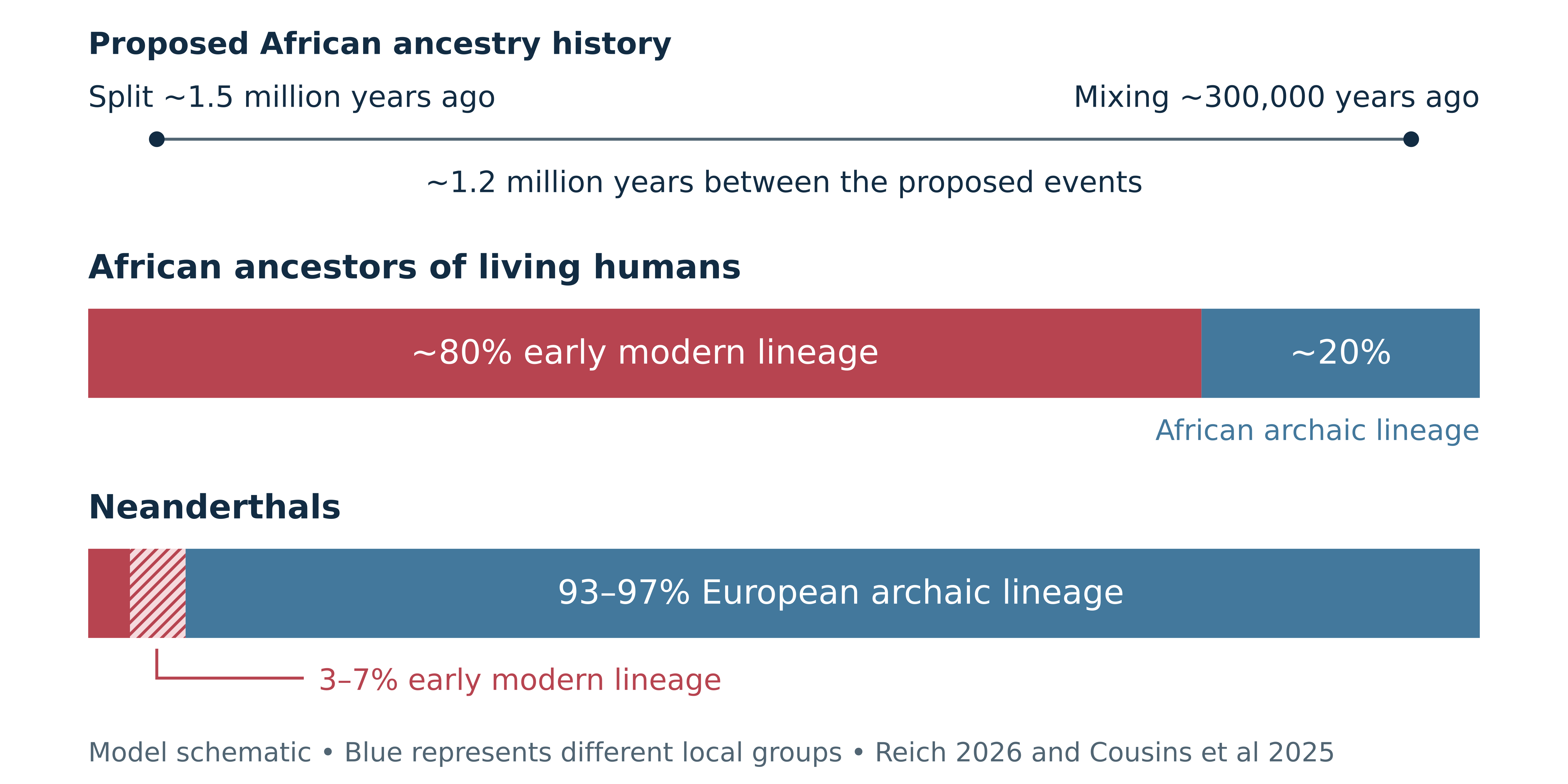
Under this reconstruction, the deep African mixture contributed to the ancestry of all living humans, including Europeans and East Asians. Reich places the proposed earlier source around northeast Africa or the Near East; its precise location remains unresolved. The later Out-of-Africa expansion follows a separate, much more recent stage of this history. [1]
A deeply separated African lineage may have supplied about 20% of our ancestry. Neanderthals left roughly 2% in many living non-Africans. Why did the deeper divide leave the larger genetic legacy?
Upgrade to read the Khan–Tabin debate, follow the human branches and migrations in a second diagram, and explore what fertile animal hybrids reveal about reproductive barriers—and what ancient interbreeding might imply about attraction.