

The Celts and the Germans emerge from ancient accounts with familiar names and uncertain beginnings. In the fifth century BCE, Herodotus placed the Celts near the source of the Danube and also in Europe’s far west. Four centuries later, Caesar distinguished the people who called themselves Celts from the Belgae and Aquitani, and placed Germans beyond the Rhine. Yet he also reported that most Belgae descended from people who had crossed that river. Earlier migrations complicated the boundary in his own account.
Tacitus, writing around 98 CE, preserved a Germanic origin story. In Germania, he recorded songs tracing descent to the earth-born god Tuisto and his son Mannus. He also argued that the Germans were indigenous and unmixed with outsiders. In the same chapter, however, he described “German” as a comparatively recent name that had spread from one group to many. A population’s ancestry and the history of its name were already different problems. The accounts leave open how the communities later associated with Celtic and Germanic languages had taken shape.
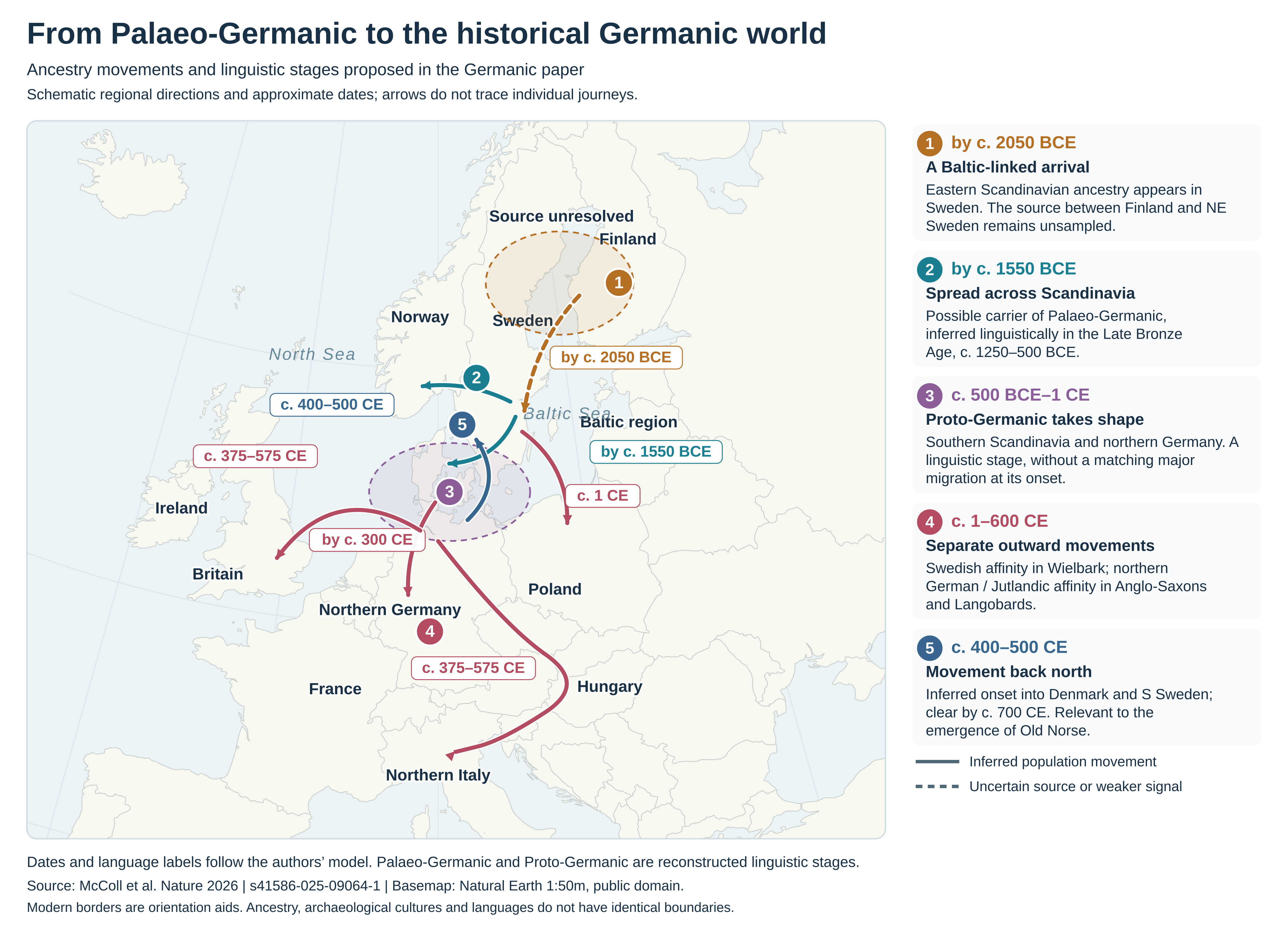
Two newly published Nature studies, Tracing the spread of Germanic languages using ancient genomics and Tracing the spread of Celtic languages using ancient genomics, reconstruct population movements through the centuries before and after these writers. Figure 1 follows the Germanic-associated movements; Figure 2 traces the dispersals across later Celtic-speaking regions. Their reconstructions bring the older puzzle within reach of a new kind of evidence: can we distinguish the populations involved genetically, and follow their differences back before the names entered history?
Figure 1 Population movements and the formation of Germanic
The overlapping movements of Celtic Europe
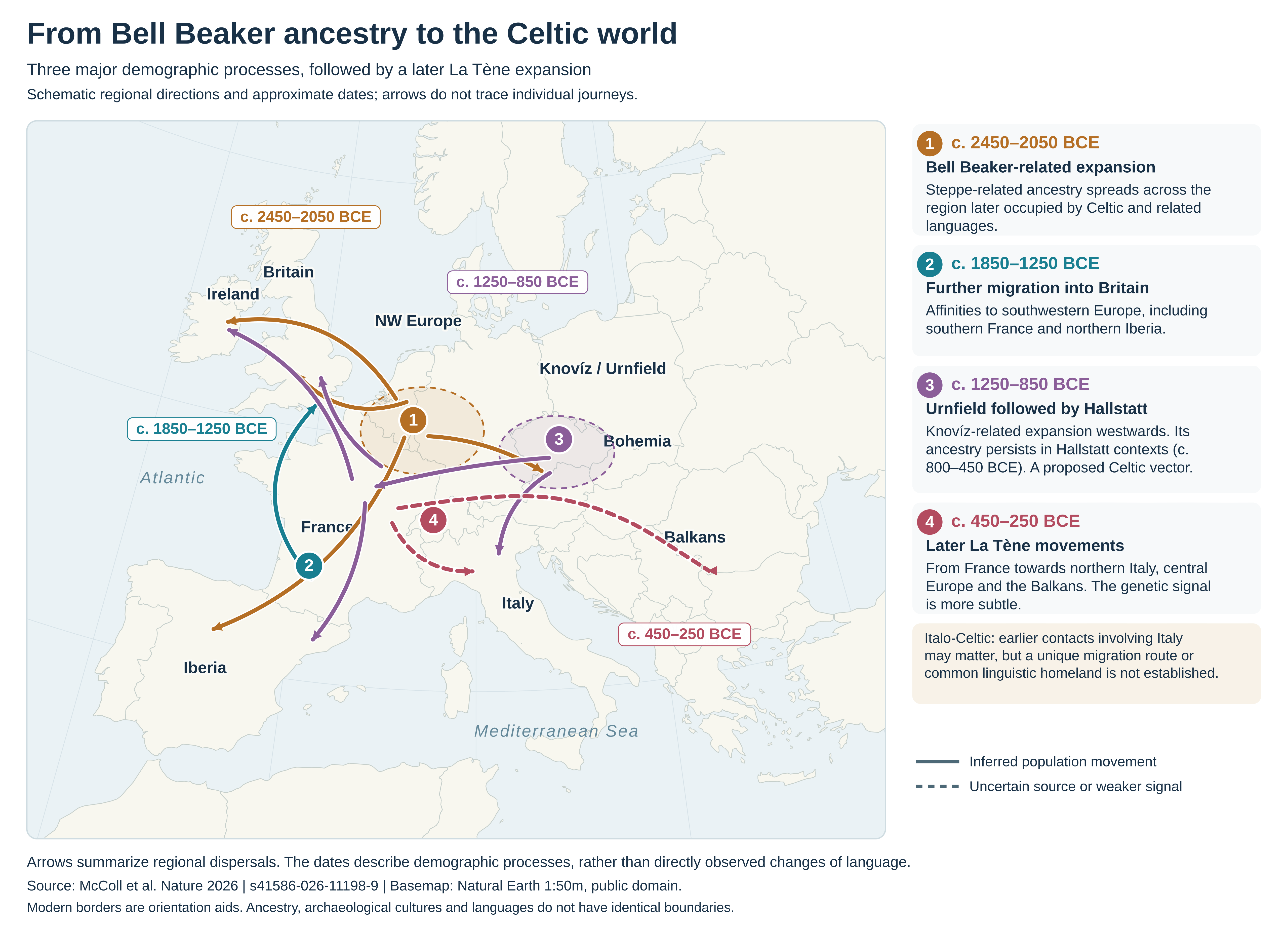
Figure 2 separates the earlier Bell Beaker expansion, subsequent migration into Britain with southwestern European affinities, and a later westward expansion associated with Knovíz and the Urnfield world around 1250–850 BCE. Knovíz is a Bronze Age archaeological culture in Bohemia, in the present-day Czech Republic. Its sampled people provide a genetic reference for this later movement. Hallstatt and La Tène belong to subsequent chapters.
Figure 2 Bell Beaker and Urnfield movements in the formation of the Celtic world
Why Bell Beaker ancestry keeps reappearing
The overlap is clearest in Britain. The Celtic paper identifies an influx of Knovíz–Urnfield-related ancestry from eastern central Europe during the Late Bronze Age, with an increase apparent in England by about 850 BCE. Its authors favour this westward expansion, broadly dated to 1250–850 BCE, as the movement that helped spread Celtic. In their preferred model, Celtic could therefore have reached Britain long after the Bell Beaker migration.
The later migrants themselves descended partly from Bell Beaker populations. During the intervening centuries their ancestors had mixed with other Europeans and developed regional genetic differences. An Urnfield-related influx could therefore alter a British community’s ancestry while preserving much of its deeper Bell Beaker inheritance. Figure 2 separates these movements because they belong to different stages of that history.
That chronology also separates the arrival of Indo-European speech from the formation of Celtic. Bell Beaker-associated movements may have carried dialects ancestral to several later branches, including Celtic. The later Urnfield-associated movement could then have spread a language already recognisably Celtic, or the innovations that turned related local dialects into Celtic varieties. The authors explicitly allow some mutual intelligibility between the newcomers and Britain’s inhabitants.
They also identify the expansion of Hallstatt C influences from the Rhine towards England and Ireland around 800–650 BCE as another possible route for Brittonic and Goidelic varieties. Their model allows several stages in the spread of Celtic, with the language carried by each movement remaining an inference.
Ancestry plots add a second source of apparent confusion. The Celtic supplement compares models using progressively more recent references. Before Knovíz is introduced, several older sources account for the ancestry of French Iron Age people. Once it is included, much of that ancestry is assigned to the newer reference, which already contains the older contributions. In Britain, introducing a British–Irish Bronze Age reference similarly absorbs ancestry previously assigned directly to Bell Beaker.
Describing a family through its grandparents rather than its great-grandparents changes the labels without changing the family’s ancestors. Something similar happens here, although genetic references are relatives of the real sources rather than a complete pedigree. A smaller Bell Beaker-labelled fraction can coexist with extensive descent from Bell Beaker people.
Those changing labels do not explain away the later migration. The authors test whether newer references improve the fit on chromosomes withheld from modelling, and compare results from several genetic methods. Those finer patterns support migration among populations that were already related. Britain could acquire Celtic speech while retaining much of its older Bell Beaker ancestry.
Can principal components follow the Germanic movements
The Germanic study reconstructs a language community that crossed older genetic divisions. By around the beginning of the Common Era, the authors argue, Germanic dialects connected populations whose genetic differences had persisted for roughly a millennium. Later movements also drew on different regional sources: northern Germany and Jutland for some expansions, eastern Scandinavia for others.
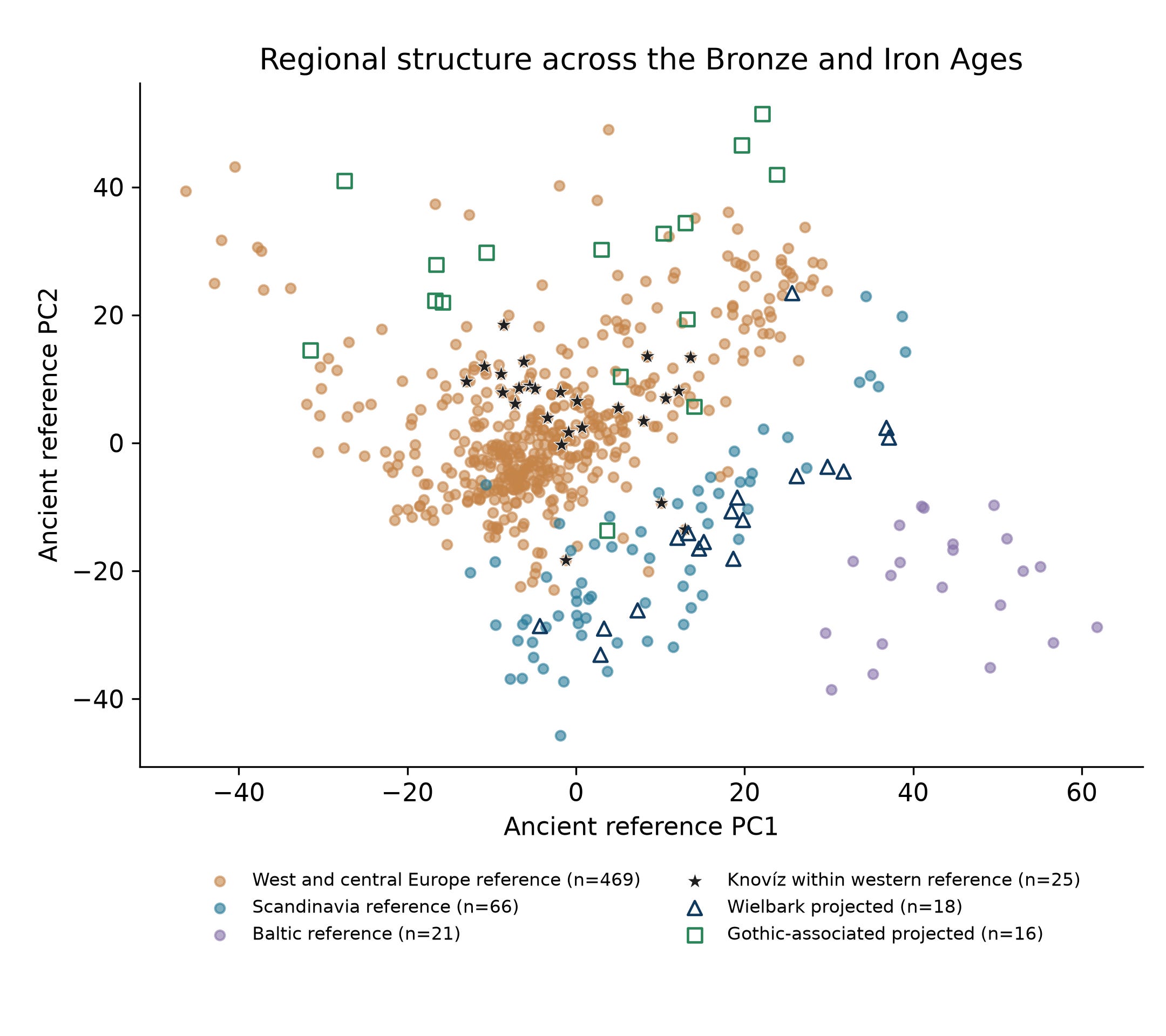
I tested whether that broad regional structure could be recovered in genomes withheld from the comparison. Principal component analysis, or PCA, summarises genetic differences along statistical axes. Figure 3 shows axes fitted to 556 references from Scandinavia, the Baltic and western or central Europe, dated roughly 1550 BCE to the beginning of the Common Era. Close genetic relatives were removed from the reference set. The positions of other genomes were then calculated using those fixed axes.
The distinction works well within this reference framework. Using ten principal components, the classifier achieved 97.1% balanced accuracy when whole archaeological sites were withheld, with a 95% interval of 94.7–98.9%. Balanced accuracy gives each of the three regional groups equal weight. With entire source studies withheld, accuracy fell to 79.0%, with an interval of 66.9–87.1%. This harder test shows how much portability can be lost when the source of the genomes changes.
Figure 3 Regional genetic structure on fixed ancient reference axes
Upgrade to paid to see my original analysis on how far back the Germanic height-score advantage can be traced and whether Iron Age Britons were genetically closer to Celtic-associated or Germanic-associated populations. Then follow the Goths south and explore what Celtiberians, Ligurians and Hallstatt reveal about the competing Celtic origin stories.