

A dog hears thunder and hides under the bed. Another sleeps through it. To study the genetics of that difference, you could ask their owners what happened and compare the dogs’ DNA. With a dog that lived thousands of years ago, you have to start at the other end. You have the DNA. What can it tell you about how the animal behaved?
Won Hee Ko and colleagues took on that problem in a new paper in Molecular Biology and Evolution. They brought together ancient dog and wolf genomes and asked whether alleles associated with fear and aggression in modern breeds already differed between prehistoric dogs and wolves. The scores for two traits, owner-directed aggression and fear of things such as loud noises or unfamiliar objects, were lower in all four ancient dog groups they compared with wolves. I found the fear difference again with a separate set of variants, though almost all of it came from one site. The question is how much of that genetic difference we can read as a difference in behavior. (Polygenic adaptation signals reveal selection on key behavioral traits early in dog domestication history)
How a breed average becomes a genetic effect
Ko and colleagues used a starkly different design from a standard human genome-wide association study (GWAS). A standard human GWAS pairs each person’s genotype with their own measured trait. Ko’s team paired each dog’s genotype with the average behavioral score for its breed, even if that dog had never been assessed. They calculated those averages from the Canine Behavioral Assessment and Research Questionnaire, known as C-BARQ. Using two modern genome panels, they tested which DNA variants tracked differences in average behavior across breeds. They then carried sets of associated variants into ancient DNA. (Ko et al., Molecular Biology and Evolution)
Figure 1 shows what goes into the analysis for a single DNA variant.
Figure 1. How Ko et al. assigned breed means in their GWAS
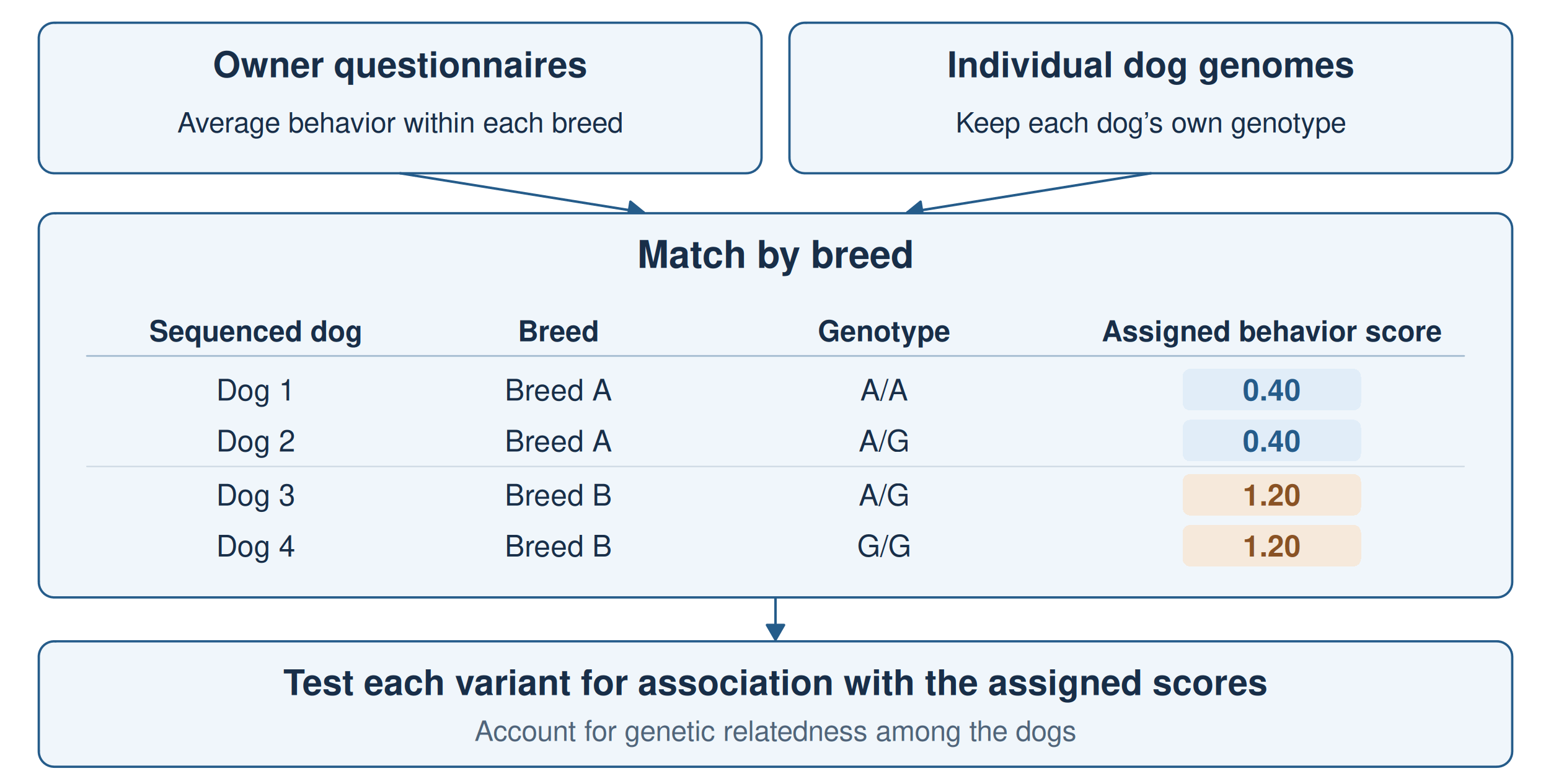
Breed averages can reveal real differences. Averaging answers across many owners can reduce noise, and the same breed-level pattern can show up in two genome panels that use the same behavioral averages. The difficulty is in working out what a marker means. Suppose two dogs of the same breed carry different alleles. One guards its food bowl and the other lets anyone near it. In Ko’s analysis those dogs have the same behavioral score. The model can account for genetic relatedness, but it has no behavioral variation within a breed to use. It estimates an association from the differences between breeds, where ancestry, appearance and the environments owners provide can all vary together.
Genetic differences between dog breeds and human populations
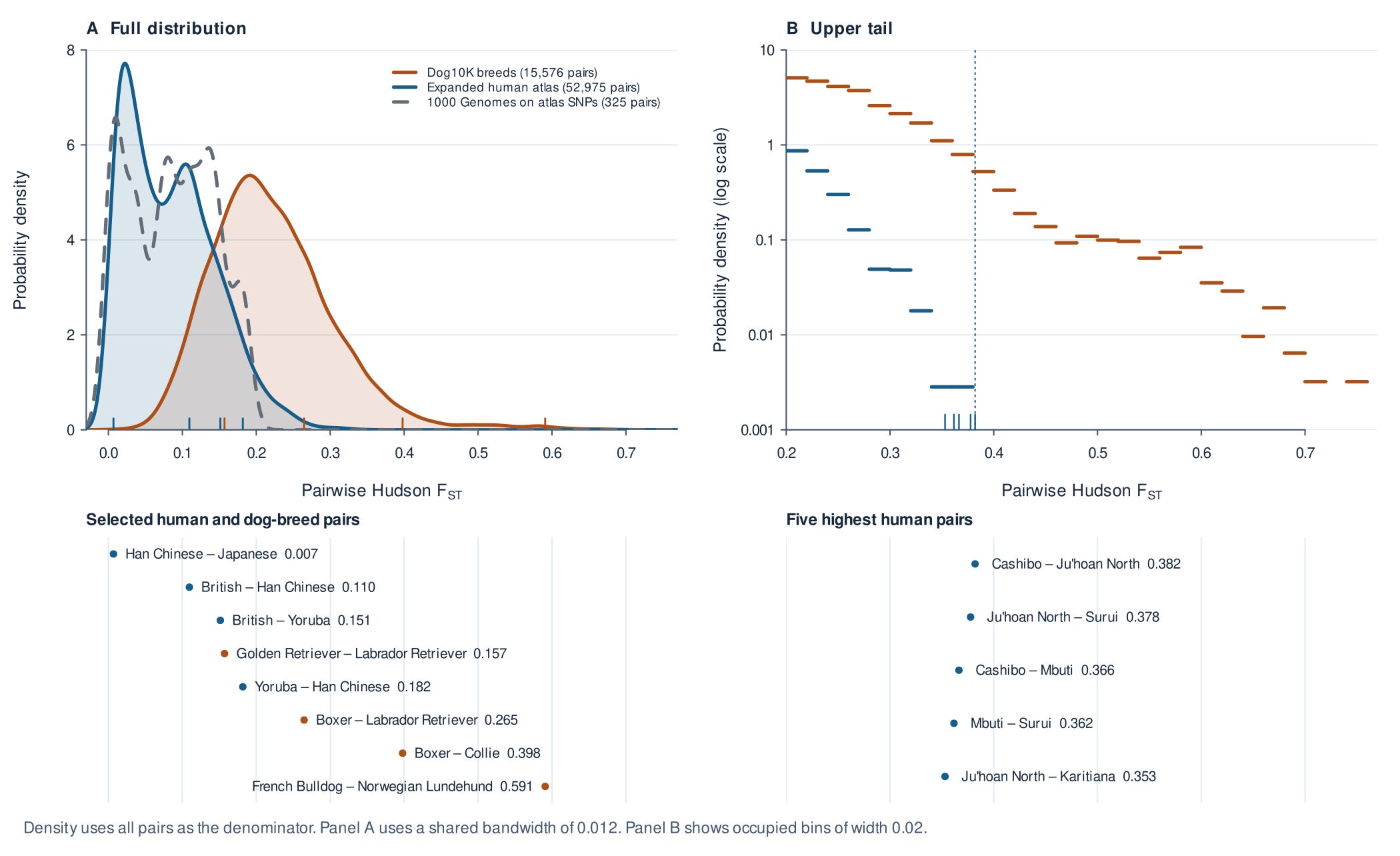
Dog breeds tend to differ more in allele frequency than human populations do. Figure 2 shows the distributions of pairwise FST, a measure of how much allele frequencies differ between groups. The median was 0.211 among pairs of dog breeds and 0.078 among pairs in the expanded human panel. There is considerable overlap. The Yoruba–Han Chinese pair, at 0.182, falls above the Golden Retriever–Labrador Retriever pair, at 0.157.
Figure 2. Genetic differentiation between dog breeds and human populations
The same design could be used in humans. Suppose you measured the same trait across several populations and had a separate set of genomes from each one. You could assign each genotyped person their population’s mean and run a genome-wide scan, as Ko did with breed averages. The associations would come from differences between populations. For a trait such as height, those differences can reflect both genetics and childhood conditions, including nutrition. Environmental differences are likely to play a much smaller role in natural hair color and baseline skin pigmentation. Measuring skin color on the inner upper arm, where it gets little sun, helps minimize the effect of tanning. Even with precisely measured population means, you would still need individual data to see whether an allele predicts the trait among people from the same population. (Morgan et al., Nature Communications · Crawford et al., Science)