

Modern humans did not simply replace every other human lineage they encountered. They mixed with them. The clearest genetic legacy of those encounters is Neanderthal DNA in living people outside Africa, joined in Asian and Oceanian populations by DNA inherited from Denisovan-related groups. These are not vague affinities. They are physical stretches of chromosome passed down from archaic-modern admixture tens of thousands of years ago.
But introgression was only the beginning. Recombination broke the imported chromosomes into smaller pieces. Drift raised some fragments and erased others. Natural selection removed many archaic alleles, while preserving or occasionally favouring others. The archaic DNA in a living genome is therefore a filtered remnant of the DNA that first entered the modern-human population.
That creates a testable question. If the surviving tracts were an approximately random sample of the donor genome, their contribution to a modern polygenic score should be the whole-genome archaic–modern difference multiplied by the proportion of chromosome copies that remain archaic. If the observed contribution differs from that proportional expectation, the retained tracts are systematically enriched for alleles pointing in one direction on the score.
I tested this idea for genetic scores for educational attainment, height and extraversion. The design has two stages. First, I compare high-coverage archaic whole genomes with the relevant modern 1000 Genomes population: three Neanderthals with Europeans, and two Denisovans with East Asians. Second, I score only the archaic local-ancestry tracts carried by present-day Europeans or East Asians. The difference between the observed local component and its proportional expectation is the statistic of interest.
This is a test of how introgressed DNA was sorted after admixture. A deviation can reflect selection on the score-associated alleles themselves or, more plausibly at many loci, selection on biological effects carried on the same haplotypes. It does not require the historical selective target to have been “education”, “height” or “extraversion” in their modern meanings.
The whole archaic genomes
I began with five high-coverage genomes: Altai, Chagyrskaya and Vindija Neanderthals, plus Denisova 3 and Denisova 25. Within each lineage comparison, every archaic individual and every modern reference individual was scored at exactly the same nonmissing sites. The Neanderthal results are the equal mean across the three genomes; the Denisovan results are the equal mean across the two genomes. Europeans are the reference for Neanderthals and East Asians for Denisovans.
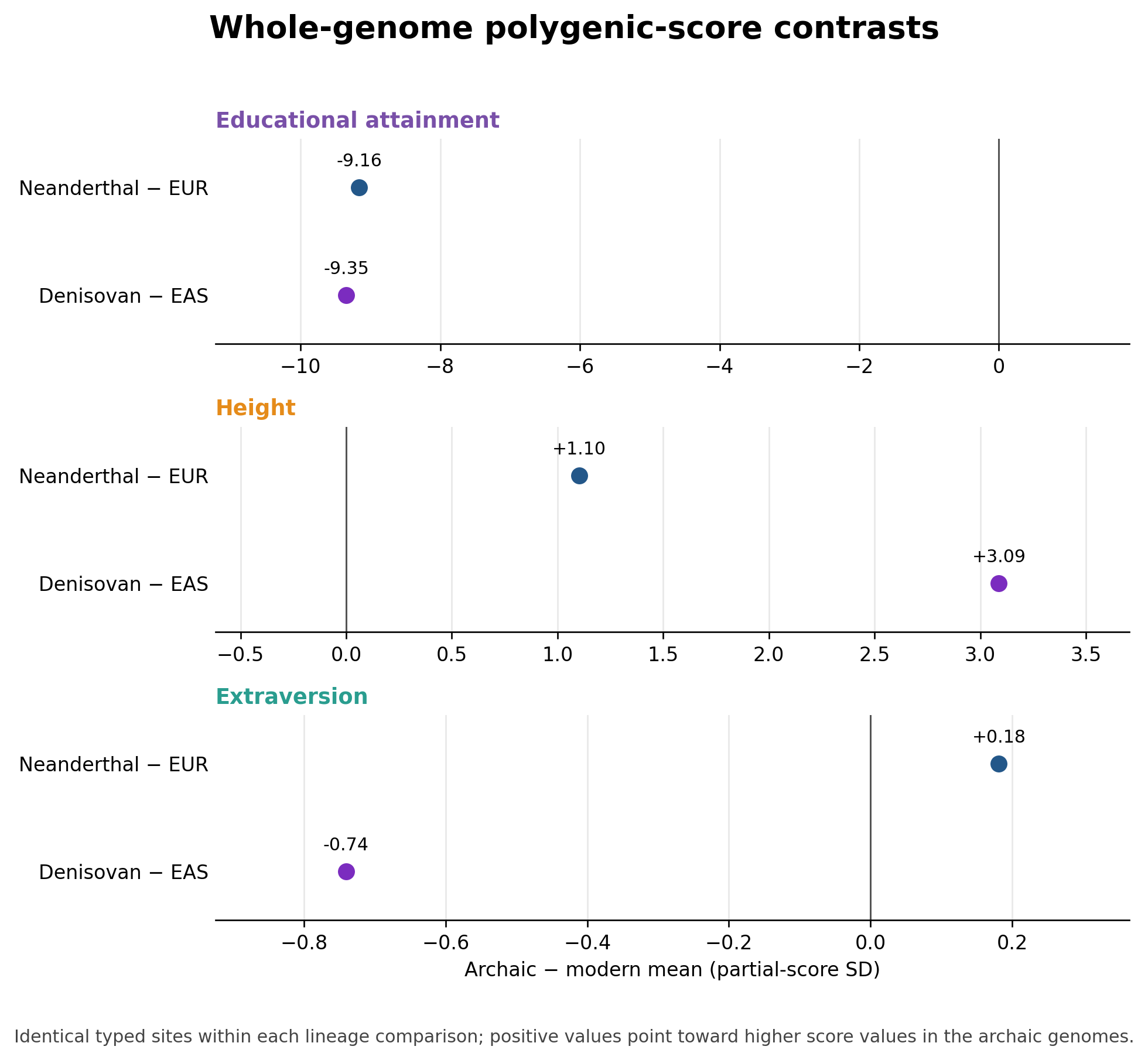
Figure 1 shows archaic minus modern values in standard deviations of the modern partial score calculated on those exact common sites. The education score is much lower in both archaic groups: −9.16 SD for the Neanderthal aggregate and −9.35 SD for the Denisovan aggregate. Those large numbers are SD units of a restricted common-site score, whose variance is much smaller than that of a genome-wide score; they are not years of schooling and should not be read as full-score population differences.
Height points in the opposite direction. The Neanderthal aggregate is +1.10 SD relative to Europeans and the Denisovan aggregate is +3.09 SD relative to East Asians. Extraversion separates the lineages: +0.18 SD for Neanderthals and −0.74 SD for Denisovans. The common-site counts were 1,684 for educational attainment, 7,947 for height and 101 for extraversion.Figure 1. Whole-genome polygenic-score contrasts
These whole-genome contrasts establish the donor-side direction. They are the counterfactual baseline for a simple model in which surviving archaic ancestry is just a small random fraction of the donor genome.
What happened to those genetic effects after admixture? Did the surviving Neanderthal and Denisovan fragments preserve the donor-genome pattern, merely shrink with the amount of archaic ancestry, or reverse direction? Next, I trace those fragments in living Europeans and East Asians, measure their contribution to each score, and test whether post-admixture selection left a directional imprint.