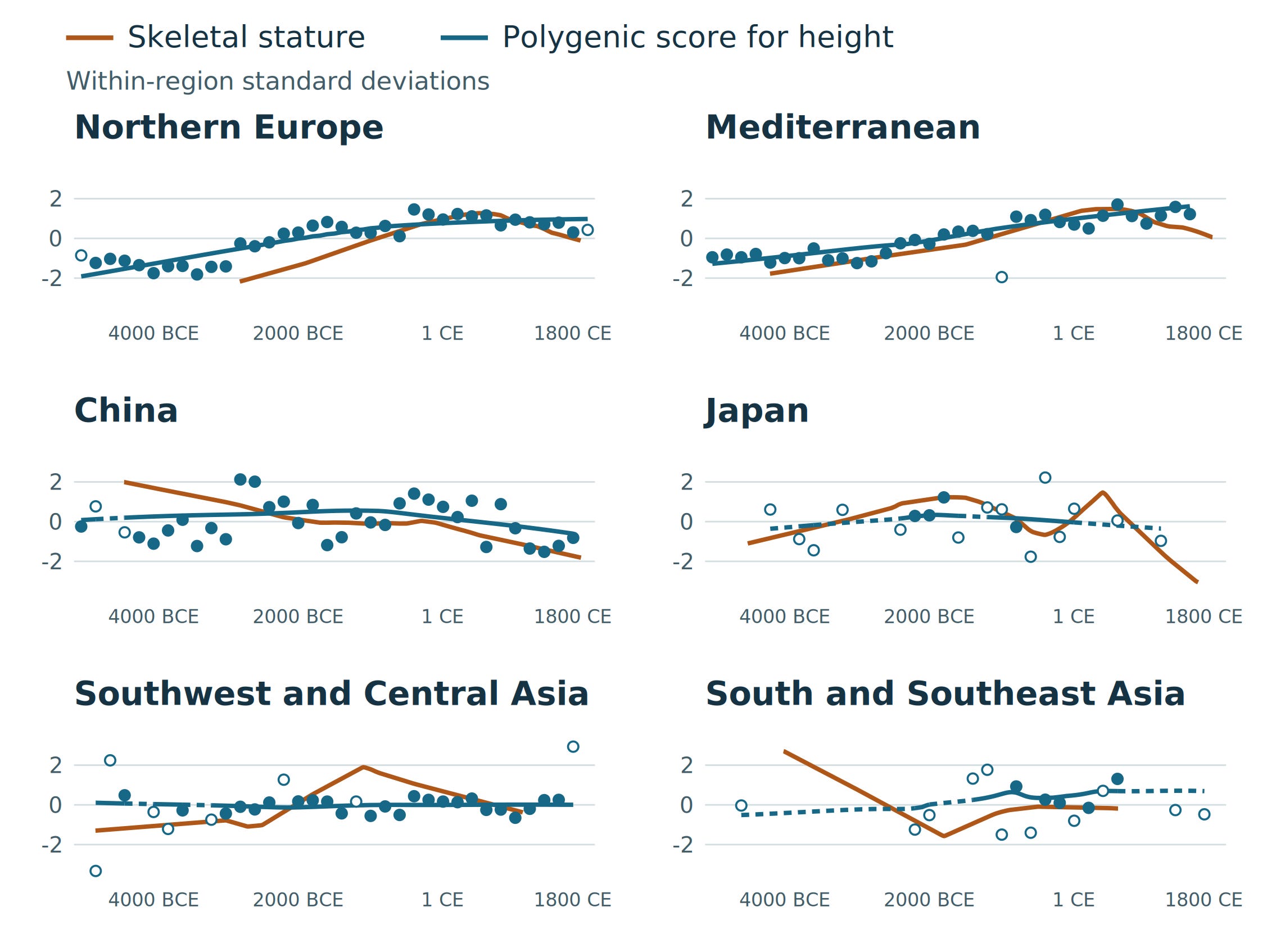
When did polygenic scores for height track skeletal stature?
Across six regions, the clearest agreement over millennia appears in Northern Europe and the Mediterranean

For much of history, we have little evidence of how well children ate or how often they got sick. But we can estimate how tall they grew from the bones they left behind. Poor nutrition and repeated illness can slow growth in childhood, which is why historians use average adult height as a clue to living conditions.
In a new PNAS paper, Joerg Baten and colleagues estimated adult stature from long bones at 783 sites across Europe and Asia. What caught my eye was the turn in the European curves. In Northern Europe and around the Mediterranean, people got taller for millennia. Then, around 500–600 CE, they started getting shorter.
Did their DNA follow them back down? I compared the estimates from the bones with average polygenic scores for height in ancient genomes from the same regions and periods. A polygenic score adds up the estimated effects of DNA variants associated with height today.
When stature peaked in Northern Europe and the Mediterranean
Around 4000 BCE, the Mediterranean skeletal series puts average adult stature at 156.4 cm. By 600 CE it had reached 162.8 cm, a gain of more than six centimetres. The polygenic score rose over those millennia too. By 1600 CE, about a third of the gain in stature had been lost. The skeletons still averaged 160.7 cm, well above the early Mediterranean estimate.
In the Mediterranean panel of Figure 1, the ochre line shows estimated adult stature from skeletons. Each blue dot shows the mean height polygenic score for the genomes sampled in a 200-year period. The blue line smooths those period means, giving more weight to nearby periods and to periods with more genomes.
The dot at 1600 CE (16 genomes) is lower than the dot at 600 CE (134 genomes). The smoothed blue line still rises because its fit draws on other periods as well. The correlation of 0.94 compares the blue polygenic score curve with the ochre skeletal stature curve over their full shared date range. The two rise together over millennia, then diverge when stature falls after 600 CE.
The Northern European skeletal record begins around 2800 BCE at 158.8 cm, then rises to a peak of 163.5 cm around 500 CE, about a century before the Mediterranean peak. From 600 to 1600 CE, stature fell by 1.4 cm in Northern Europe and 2.1 cm in the Mediterranean. By 1600 CE the northern estimate was still 162.0 cm. Its smoothed polygenic score had risen through the long increase in stature and edged upward only slightly as stature fell.
In China and Japan, both fitted curves slope downward after 600 CE. Over the next six centuries, the skeletal estimate falls by 0.8 cm in China and 4.6 cm in Japan. The Japanese DNA record is much thinner over that interval. It has four people in the period centred on 600 CE and one in the period centred on 1200 CE, with no sampled genomes in between.
Figure 1. Skeletal stature and polygenic scores for height across six regions