

In Were Celts and Germanics Genetically Different?, I found that the ancient populations grouped under the Celtic label did not form one tight genetic cluster. In my genetic-distance comparisons, the ancient Celtic groups were, on average, farther from one another than from the later Germanic groups. Hugh McColl and colleagues’ Tracing the Spread of Celtic Languages using Ancient Genomics identifies an eastern Central European expansion that could help explain how Celtic speech spread. [1, 3]
A language can spread with migrants who mix with local populations along the way. The resulting communities can share a language without forming a tight genetic cluster. Their proposed expansion could therefore help explain the diversity I found.
The regional pattern in my earlier results
I compared ancient and later populations using the Allen Ancient DNA Resource. One set of tests measured which of two reference groups a population shared more genetic history with; another measured overall genetic distances. The Celtic references included Iron Age Britain, Gaulish and Central European La Tène groups, and Hallstatt. [3]
The clearest continuity on the Celtic side was local. The medieval Irish and Pictish groups in my comparison leaned towards Iron Age Britain over Iron Age Scandinavia. They did not show the same clear preference for every continental Celtic reference. The later Saxon and Viking comparisons gave a more consistent Scandinavian pull. [3]
Small ancient samples, local drift and uneven sampling can also exaggerate genetic distances, as I noted in the earlier post. The stronger evidence for local continuity came from the directional allele-sharing comparisons. [3]
What the migration study adds
McColl and colleagues use shared stretches of DNA to reconstruct finer population connections. Their preprint links a westward ancestry expansion to Knovíz, an archaeological group in Bohemia within the Late Bronze Age Urnfield world, and traces connections into later Hallstatt and La Tène contexts. [1]
The accepted abstract distinguishes three relevant movements: Bell Beaker-associated dispersal after about 2450 BCE, an earlier southwestern connection into Britain around 1850–1250 BCE, and the Knovíz/Urnfield-related expansion around 1250–850 BCE. It favours the last as the most economical explanation for Celtic dispersal. Figure 1 locates those broad connections. [2]
Figure 1. Three movements discussed in the Celtic homeland debate
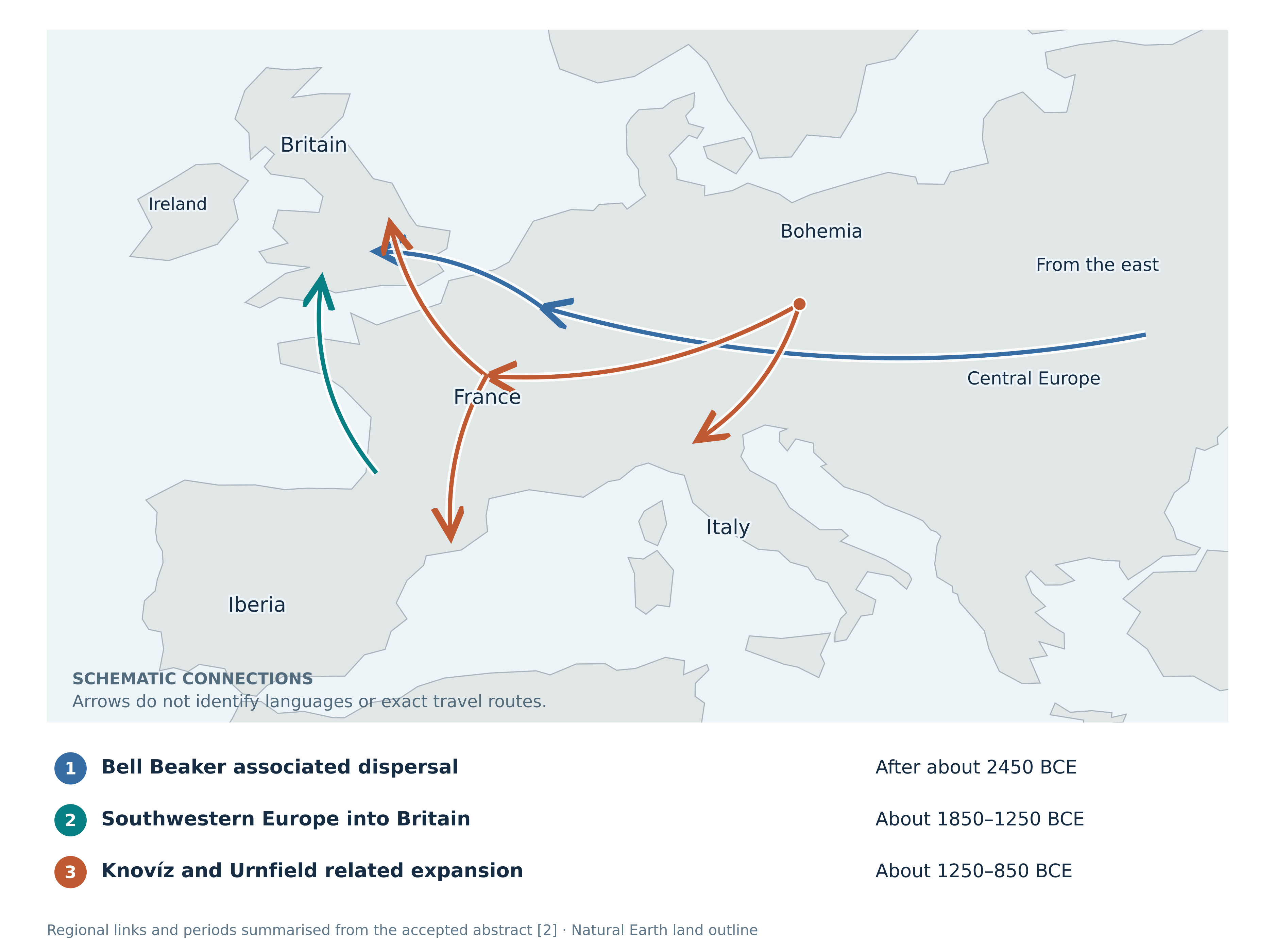
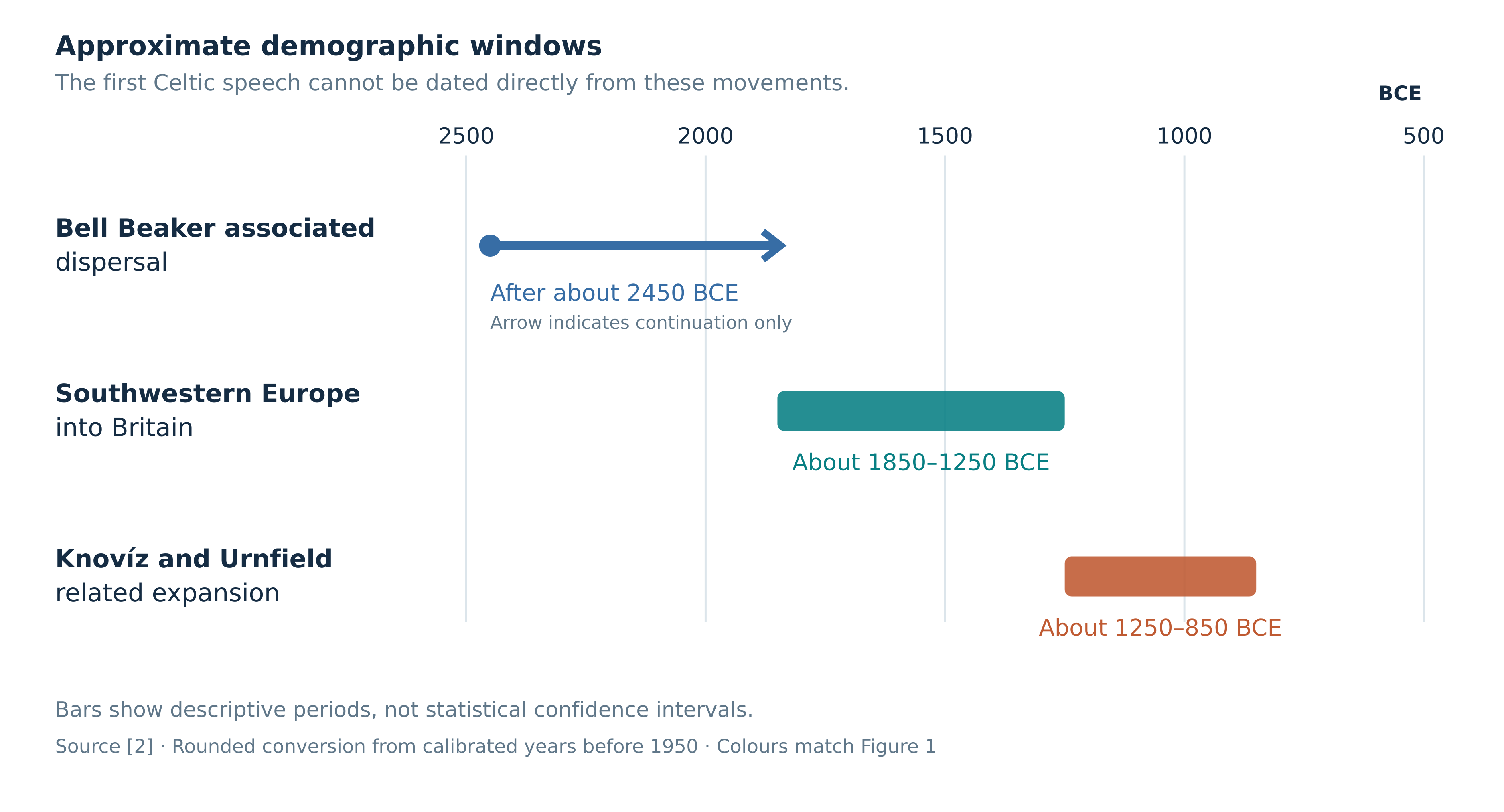
Figure 2 separates the older Bell Beaker transformation from the later Bronze Age movements. The arrival of steppe-related ancestry predates the expansion favoured for Celtic dispersal.
Figure 2. Three demographic episodes that could matter for Celtic
How the DNA segment method works
DNA is inherited in stretches, which recombination breaks into smaller pieces over generations. A matching stretch inherited from a common ancestor is an identity-by-descent (IBD) segment. Longer shared segments generally point to more recent common ancestry.
For each individual, the authors summarise how much DNA is shared with each genetic cluster, adjusting for the number of people sampled in that cluster. They then fit this sharing profile as a mixture of profiles from candidate source populations to estimate their relative ancestry contributions. The model uses sharing across the wider dataset, rather than just a single pair of genomes. [1]
A shared migration without a uniform population
A migration can contribute to several populations without making them each other’s closest relatives. My comparisons measured the relationships among later populations; they could not determine which earlier movement brought a language into each region.
I described Hallstatt and La Tène as pointing to the original Celtic homeland. McColl and colleagues favour an expansion that began earlier, in the Late Bronze Age Urnfield world. If it carried Celtic, the language was already spreading before those later archaeological traditions. Their association with Celtic-speaking regions cannot, on its own, locate the first Celtic speakers. [1, 3]
Why Britain still makes me cautious
In Large-scale migration into Britain during the Middle to Late Bronze Age, Nick Patterson and colleagues identified substantial continental migration involving people genetically similar to ancient individuals from France. They proposed a plausible route for early Celtic speech. Their results place an important ancestry change in southern Britain around 1000–875 BCE, incorporating arrivals over preceding centuries. [4]
Lara Cassidy and colleagues’ Continental influx and pervasive matrilocality in Iron Age Britain then argued for further continental influence during the Iron Age, varying between regions. They discuss how later contact might have affected Celtic languages already spoken around the Channel. [5]
Celtic could have developed further east and reached Britain through France. Later migrants could then have reinforced an existing language or introduced a different variety. Britain’s repeated continental contacts make it difficult to assign its Celtic speech to one arrival.
The local continuity in my Irish and Pictish comparisons is compatible with that history: much of their ancestry could have persisted while speech changed through continental contact.
Where the language question remains open
The preprint argues sharply against western and central origin models. The accepted abstract explicitly accommodates an earlier southwestern movement compatible with Atlantic formation scenarios, while still preferring the later eastern expansion. [1, 2]
I find the eastern expansion a plausible vehicle for Celtic dispersal. Establishing that its migrants spoke Celtic still requires evidence about language. They could have carried it west, adopted it along the way, or spread a later variety among communities already speaking Celtic.
Methods and source notes
The earlier post was published on 11 May 2026; the McColl preprint dates to 2025. The earlier comparisons have not been rerun. [1, 3]
Public preprint v2 analyses 4,587 individuals: 578 newly generated individuals from PRJEB87274 and 4,009 previously published individuals. The 578 belong to an accompanying study’s larger set of 712 new genomes. The accepted abstract also reports 4,587 individuals. Its complete manuscript is embargoed; detailed methods here are attributed to preprint v2. [1, 2]
The earlier analysis used allele-sharing tests (f4 statistics) and Hudson genetic distances (FST); the migration study relies on shared inherited DNA segments for its principal fine-scale modelling. [1, 3]
Dates in Figures 1 and 2 are rounded from calibrated years before 1950: 4400 BP to about 2450 BCE, 3800–3200 BP to about 1850–1250 BCE, and 3200–2800 BP to about 1250–850 BCE. They are approximate demographic periods, not confidence intervals or direct dates of language change. Map arrows show schematic regional connections rather than exact routes; the later window does not date every regional endpoint. [2]
References
[1] McColl, H., et al. (2025). Tracing the Spread of Celtic Languages using Ancient Genomics. bioRxiv. https://doi.org/10.1101/2025.02.28.640770. Version used here: public full text v2. Read source
[2] Willerslev, E., McColl, H., Kroonen, G., Kristiansen, K., & Sikora, M. (2026). Tracing the spread of Celtic languages using ancient genomics. Cambridge Apollo accepted-version record, repository DOI 10.17863/CAM.135565; journal listed as Nature. Public abstract and metadata only; author listing follows the repository record. Read source
[3] Piffer, D. (2026, May 11). Were Celts and Germanics Genetically Different? PifferPilfer. Read source
[4] Patterson, N. et al. (2021, online publication). Large-scale migration into Britain during the Middle to Late Bronze Age. Nature. Print edition: 601, 588–594 (2022). Read source
[5] Cassidy, L. M., Russell, M., Smith, M., et al. (2025). Continental influx and pervasive matrilocality in Iron Age Britain. Nature, 637, 1136–1142. Read source
Very nice discussion! As usual, you are very careful to point out the limitations in the various studies. Are any of the results affected by the recent revelation that the BB peoples - who did dominate the migration into Britain - "percolated" in the Rhine-Meuse rivers' wetlands for a significant period of time before making the big successful migration? Are the later expansions' people distinguishable (since presumably they didn't experience the same sojourn)?