Can Burials and Ancient DNA Tell Us Who Left More Descendants?
Burial status, genetic scores for education, and the families we can trace

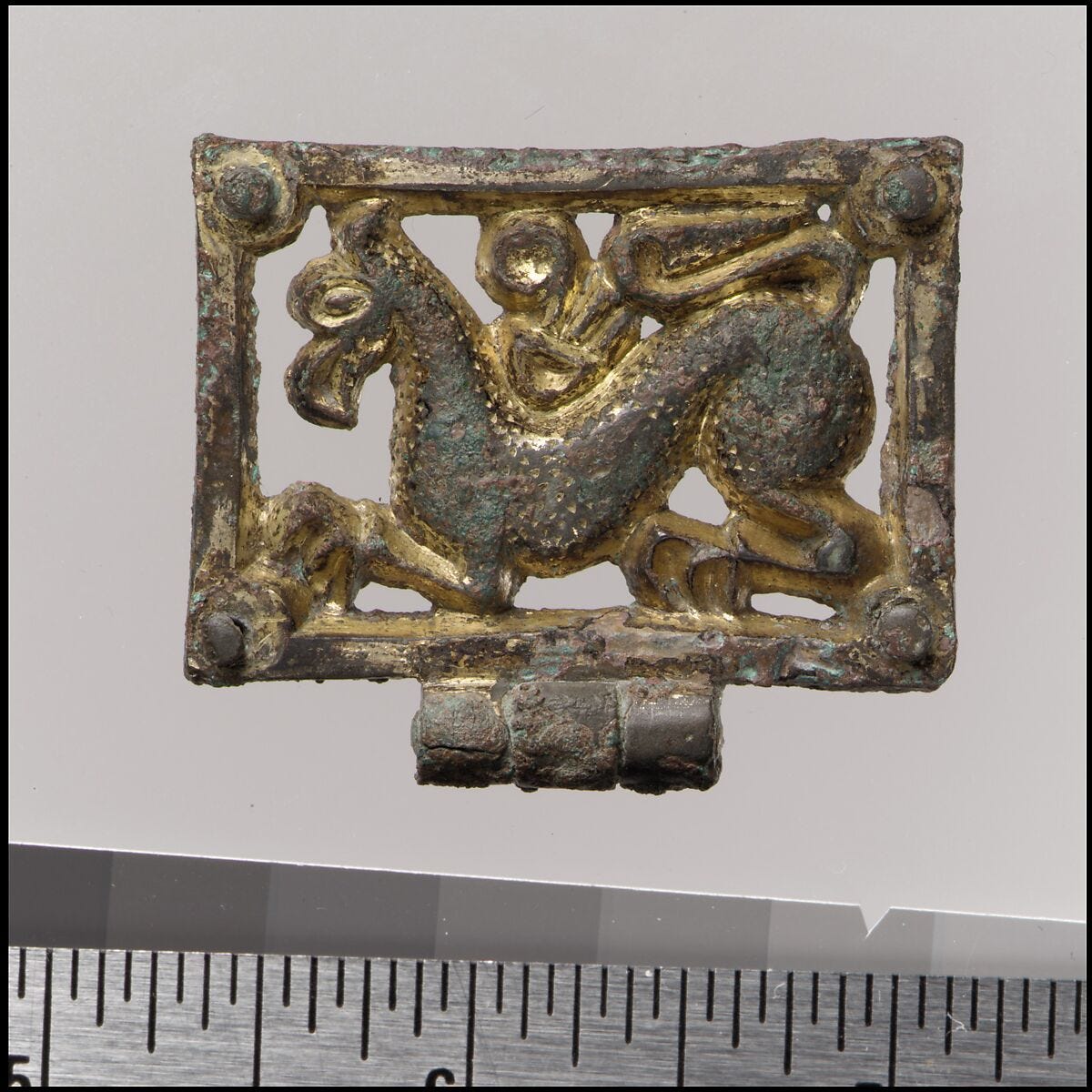
At Leobersdorf, an Avar cemetery near Vienna, researchers used DNA from the burials to trace a family across six generations. Some graves held belt sets or coat clasps, possible signs of social standing (see Figure 1 for a period example). (Wang et al. 2025)
That family tree made me wonder how much ancient DNA could tell us about reproductive success. Could we trace more descendants for people with richer burials? What about people with higher genetic scores for educational attainment?
Emil Kirkegaard and I found that these scores rose over time in ancient European genomes, even after we accounted for ancestry. Using ancient genomes from across West Eurasia, Akbari and colleagues later found evidence of natural selection favouring variants linked to more years of schooling today. If people with higher scores tended to leave more descendants, that could help explain the rise. (Piffer and Kirkegaard 2024, Akbari et al. 2026)
Figure 1. An Avar belt fitting
In my earlier post I found that, even among relatives in the same family, people with higher polygenic scores for fluid intelligence tended to have richer burials. The pattern was clearer in some models than in others. (Were Ancient Elites Genetically Different or Just Related?)
Who shares DNA?
To see which people in the cemeteries were likely related, I looked for long stretches of DNA they’d both inherited from a common ancestor. That kind of sharing is called identity by descent, or IBD. I used it to flag which pairs had a DNA link. (Ringbauer et al. 2024)
I could find those links from the DNA alone. For Table 1, I added a split by generation. I used screened pairs from the same cemetery and documented family tree, which told me who was on the same level and who was a generation or more apart. (Wang et al. 2025, Gnecchi-Ruscone et al. 2024, Rivollat et al. 2023)
EA4 is an educational attainment polygenic score, built by adding up DNA variants weighted by how strongly they were linked to years of schooling in a modern study. I averaged each pair’s scores and also accounted for how far apart they were. (Okbay et al. 2022)
Across generations, a one-point rise in the pair’s average EA4 went with about 30 percent higher odds of a DNA link. The estimate was similar for people in the same generation. The other four scores showed little association in these families. Table 1 shows the comparison.
Table 1. Genetic scores and DNA links in documented families
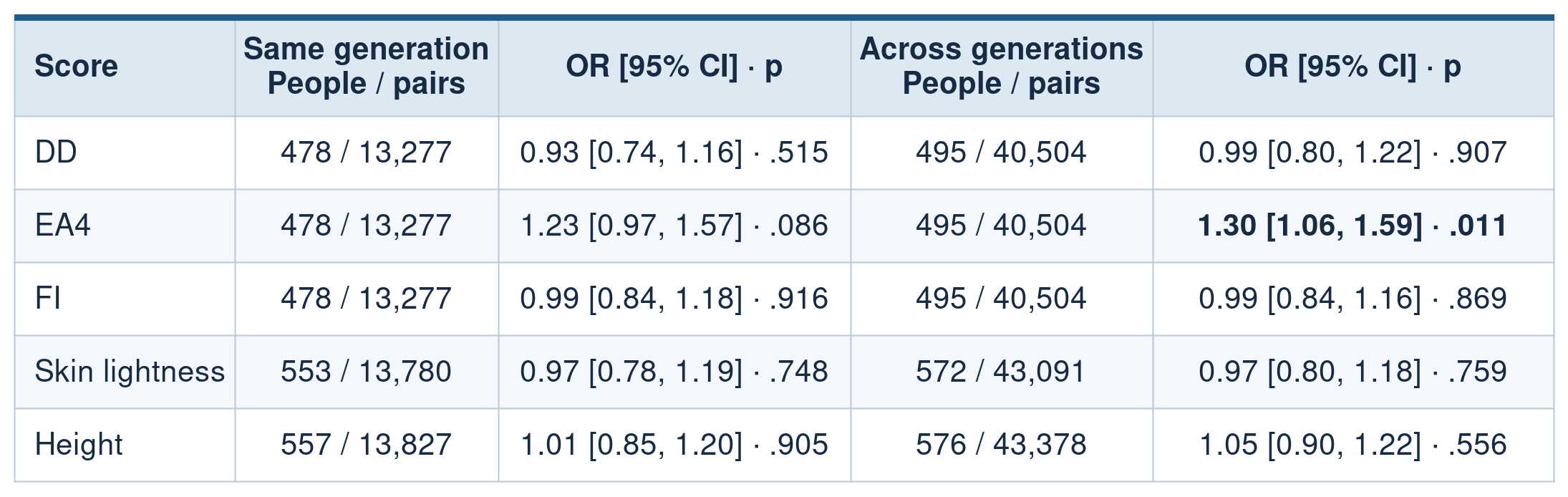
How I counted links. A link required two shared segments longer than 12 centimorgans, one longer than 16. Models accounted for pedigree, sex, dates and imputation uncertainty.
Back to the belts and clasps
A grave filled with pottery and a grave with one unusual clasp can look rich in different ways. I tried three scores. COVI counts objects and weights them by their value in context. CSI gives more weight to locally scarce objects. QuantWealth prestige looks at the kinds of objects typically found in richly furnished graves. (Nørtoft and Rohrlach 2026)
The clearest pattern was among people in the same generation. Pairs with higher object value or prestige were more often related. Pairs with similar prestige also tended to share DNA, even at the same average level of prestige. Across generations, average prestige still showed an association. The scarcity score was harder to read in either group. Figure 2 shows how the three scores compare.
Figure 2. Grave goods and DNA links
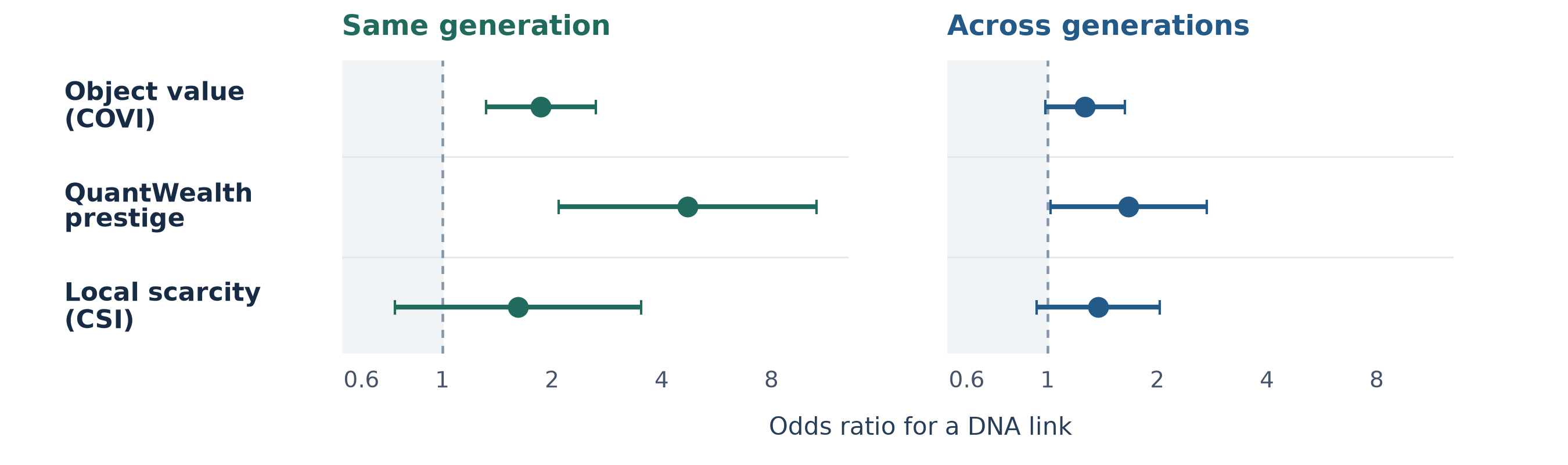
One cemetery, Rákóczifalva, supplied more than half of the same-generation pairs with object-value scores. The COVI pattern within generations held when I left it out. The across-generation estimate was clearer without that site, and the within-generation association remained larger.
Across generations, pairs with a belt set or coat clasp in both graves had about twice the odds of a DNA link as pairs with neither, and about 1.7 times the odds of pairs with one. Within generations the ornament results were less clear.
I added delay discounting, EA4 and fluid intelligence on a smaller set of pairs. The associations with object value, prestige within generations and ornaments across generations held. EA4 also barely moved when I added ornaments to its own model.
Upgrade to paid to see what happens when I separate parent–child links from full-sibling links. You’ll see the results side by side for burial ornaments and genetic scores for education. If you’ve ever wondered whether a cemetery can tell us who left bigger families, this is where the DNA gets us closest to an answer.