

Writing in the eighth century, Bede traced the origins of the English to Angles, Saxons and Jutes who crossed the sea and settled in Britain. In his account, the newcomers became conquerors of the people who had invited them. His history preserves the memory of a profound change after Roman rule. Britain became the home of a new people speaking a Germanic language. Bede, Ecclesiastical History I.15
The two new Nature studies, Tracing the spread of Celtic languages using ancient genomics and Tracing the spread of Germanic languages using ancient genomics, give me the reference samples to investigate that change myself. This post presents my original analysis: I use their published samples as references and compare additional ancient and modern British genomes with them.
What excites me is that I can finally distinguish Celtic- and Germanic-associated genetic profiles with some confidence and use that distinction to investigate ancestry through time. In The unresolved history of Celtic and Germanic Europe, I established the comparison. Here I follow it from Iron Age Britons through Anglo-Saxon cemeteries, the Viking Age and later medieval England. Did the settlers’ genetic profile remain dominant? And why can a modern British genome look closer to a Celtic-associated reference while still carrying substantial ancestry from Germanic migrants?
Following the change through the genomes
I use the same two reference groups throughout: continental Iron Age people associated with Celtic archaeological contexts, and ancient southern Scandinavians from the region associated with the early Germanic speech community. I compare each British genome with both groups using principal component analysis, or PCA, which places genomes along axes of genetic variation. I retain its distance from each reference and follow the continuous change in relative affinity through time.
The continuous index is positive towards the Germanic-associated reference and negative towards the Celtic-associated reference. Zero marks equal distance from the two centres. I also count how many people fall on either side, but a genome just below zero and one far towards the Celtic reference should not be treated as equivalent. The full distribution is the more informative result for populations formed through mixture.
Figure 1 shows the sequence. The Iron Age and Roman genomes mostly sit on the Celtic-associated side. A large shift appears among the Anglo-Saxon cemetery genomes. Later medieval Cambridge moves back towards the western European side of the comparison, much closer to the modern British distribution. I use ancient genomes with more than 0.5× documented coverage for these ancestry results, and examine other thresholds below.
Figure 1. Celtic and Germanic reference affinity through time
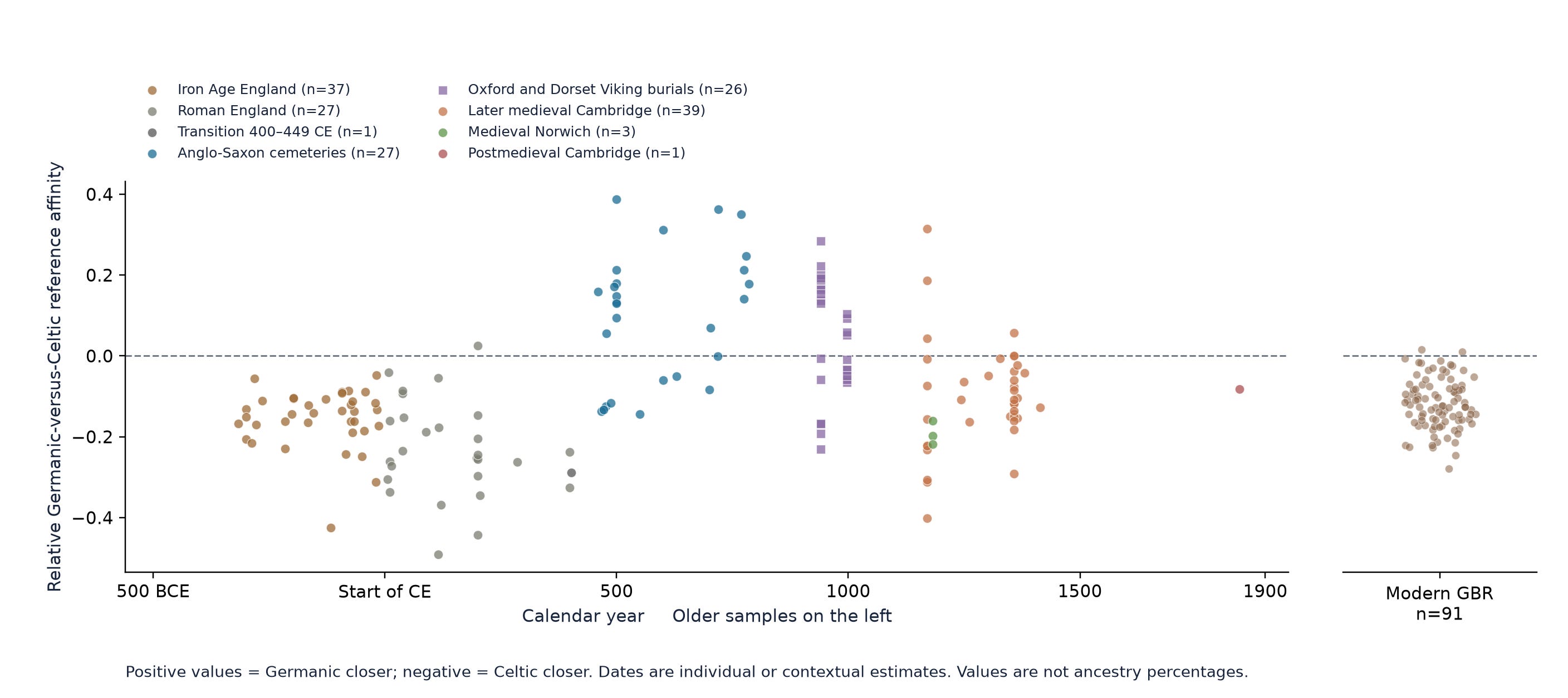
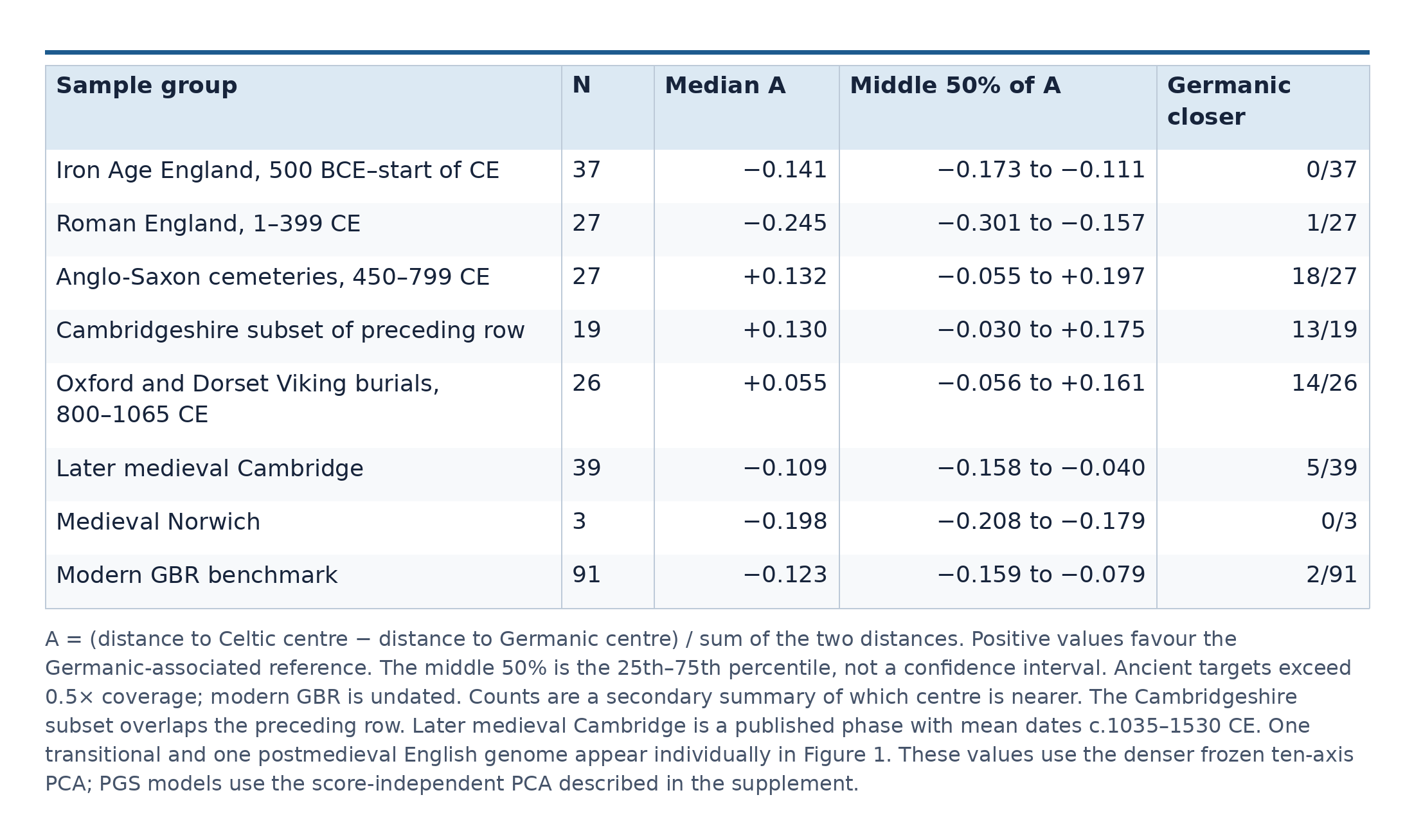
Table 1 summarises the distributions. The median affinity rises from −0.141 in Iron Age England and −0.245 in Roman England to +0.132 in the Anglo-Saxon cemeteries. Later medieval Cambridge has a median of −0.109. The Anglo-Saxon middle half spans −0.055 to +0.197, showing substantial variation among the people buried in these cemeteries. Counts of the people crossing zero accompany those values as a secondary summary.
Table 1. Continuous reference affinity through time
The Anglo Saxon shift and the people it brought together
The post-Roman change falls where I would expect a substantial North Sea migration to appear. The Nature study by Gretzinger and colleagues established large-scale migration into early medieval England from the continental North Sea zone. My comparison detects a corresponding shift towards the southern Scandinavian reference. The agreement is especially useful because this is a different measurement: I am following positions in PCA space rather than reproducing their ancestry-mixture estimates.
The cemeteries also show how varied the resulting population was. At the main coverage threshold, six of seven people from Hatherdene Close are Germanic-closer, as are four of six from Oakington and all four from Sedgeford. At Ely, only one of three falls on that side. Table S3A in the supplement gives the full cemetery breakdown. The surviving samples are small, but their variation matters. The same period and archaeological setting contain people with markedly different genetic affinities.
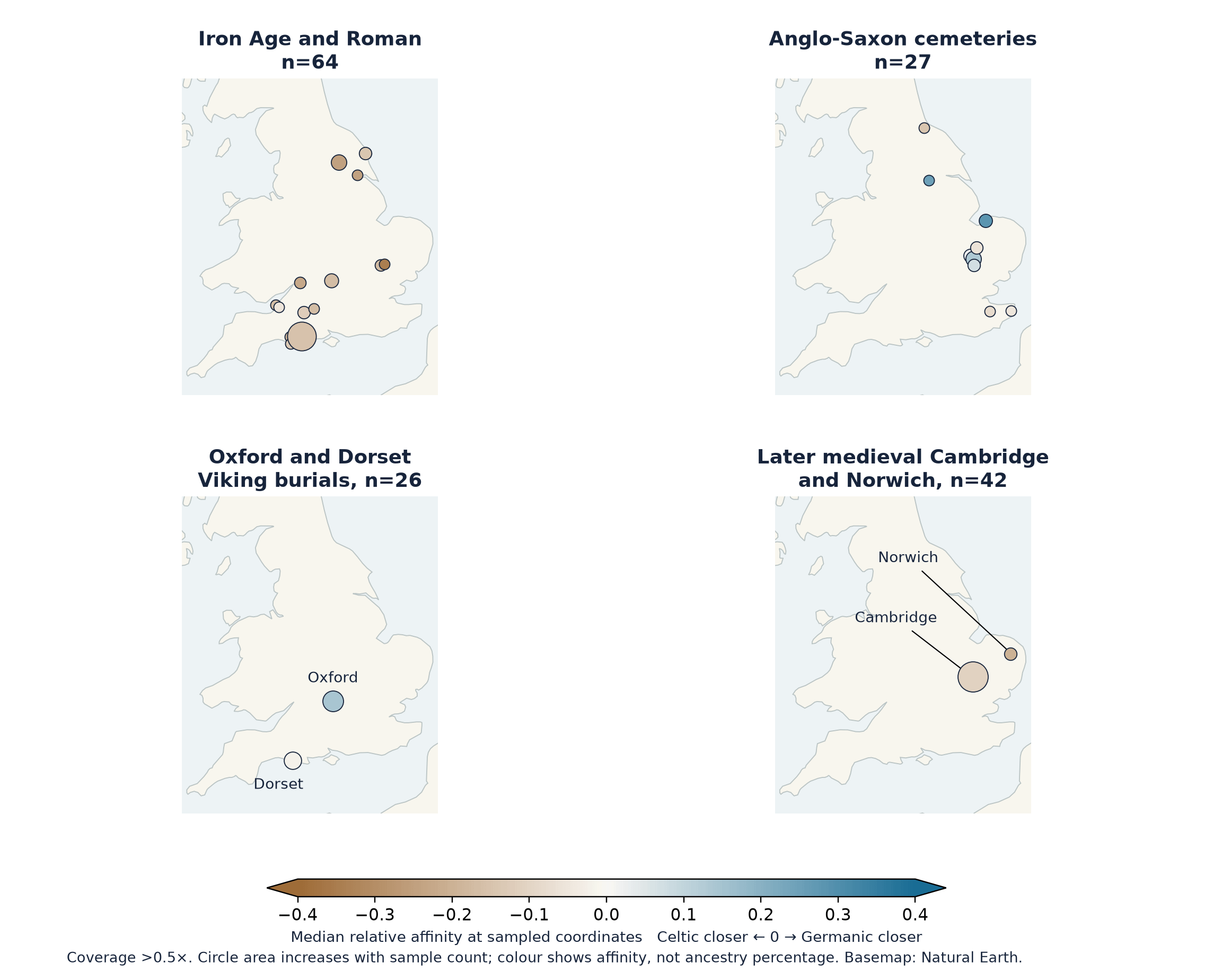
Figure 2 places those results on the map. The higher-coverage Anglo-Saxon genomes extend across several eastern English cemeteries, whereas the later medieval comparison is concentrated in Cambridgeshire and Norwich. This changing geography is part of the explanation for the changing averages.
The Viking-period row in Table 1 needs particular attention. All 26 qualifying genomes dated 800–1065 CE come from the Oxford and Dorset burials in Population genomics of the Viking world. Fourteen are Germanic-closer. These assemblages provide evidence about particular groups buried in England during the Viking Age.
Figure 2. Where the genomes in the time series were buried
Upgrade to paid to follow the shift from Anglo-Saxon cemeteries to medieval Cambridgeshire and modern Britain, and see why substantial Germanic ancestry can coexist with a genetic profile closer to the Celtic-associated reference. I also compare Ireland’s Bronze Age genomes and Viking-associated burials, examine people from the same English county and test how much the results depend on DNA quality.