Celts, Germans and the genetic history of Italy
Celtic and Germanic genetic signals from the Bronze Age to medieval Italy

When Livy described the Gauls crossing the Alps, he was explaining how much of northern Italy had once belonged to peoples whom Rome later conquered. Celtic inscriptions survive around the northern Italian lakes from the first millennium BCE. Further movements brought Gaulish groups into the Po Valley in the fifth and fourth centuries BCE. The geography was specific: eastern Piedmont, Lombardy and the plain stretching east towards the Adriatic. The Celtic languages of ancient Italy; Piana Agostinetti on the Celts of Italy.
Germanic migrations belong to a later chapter. Theodoric’s Ostrogoths entered Italy in 489 CE and established their kingdom in 493, with Ravenna as its capital. In 568, the Lombards crossed from Pannonia through the northeastern approaches and took much of northern Italy, later establishing duchies at Spoleto and Benevento. Slavic movements reached the eastern Alpine and Friulian borderlands during the early Middle Ages. These were movements into particular parts of Italy, separated by centuries. Can we recognise their different histories in the DNA? Ostrogoths in Italy; the Lombard migration; Slavs in early medieval Italy.
In The unresolved history of Celtic and Germanic Europe, I examined the new Nature studies Tracing the spread of Germanic languages using ancient genomics and Tracing the spread of Celtic languages using ancient genomics. My additional analysis showed that western/central European and Scandinavian reference groups could serve as genetic proxies for Celtic-associated and Germanic-associated populations. Here I carry those comparisons into Italy, using genomes from the same compiled ancient collections and adding a local reference of Etruscan, Picene and Iron Age or Republican Lazio people.
I used principal component analysis, or PCA, to place the genomes along axes of genetic variation, then trained a classifier to compare their positions with the four reference groups. I retain the geographical names on the plots so readers can see which genetic proxies I am using. A probability of 99% means strong support for one reference class among these four alternatives; it is not a claim of 99% ancestry from that people. I explain the reference selection and validation in the appendix.
Celtic and Germanic proxies in modern Italy
I began with modern Italy. In Figure 1, the western/central European Celtic proxy and the Scandinavian Germanic proxy both become more prominent in the north, but their geography differs. The western/central map darkens most strongly towards Piedmont and Cuneo, while the Scandinavian map picks out parts of the Alpine arc and the northeast. A smaller Baltic concentration appears in Friuli. Each panel has its own colour range, so the map shows where a signal is concentrated as well as how large its probability is.
Figure 1. Modern Italian affinities to four ancient references
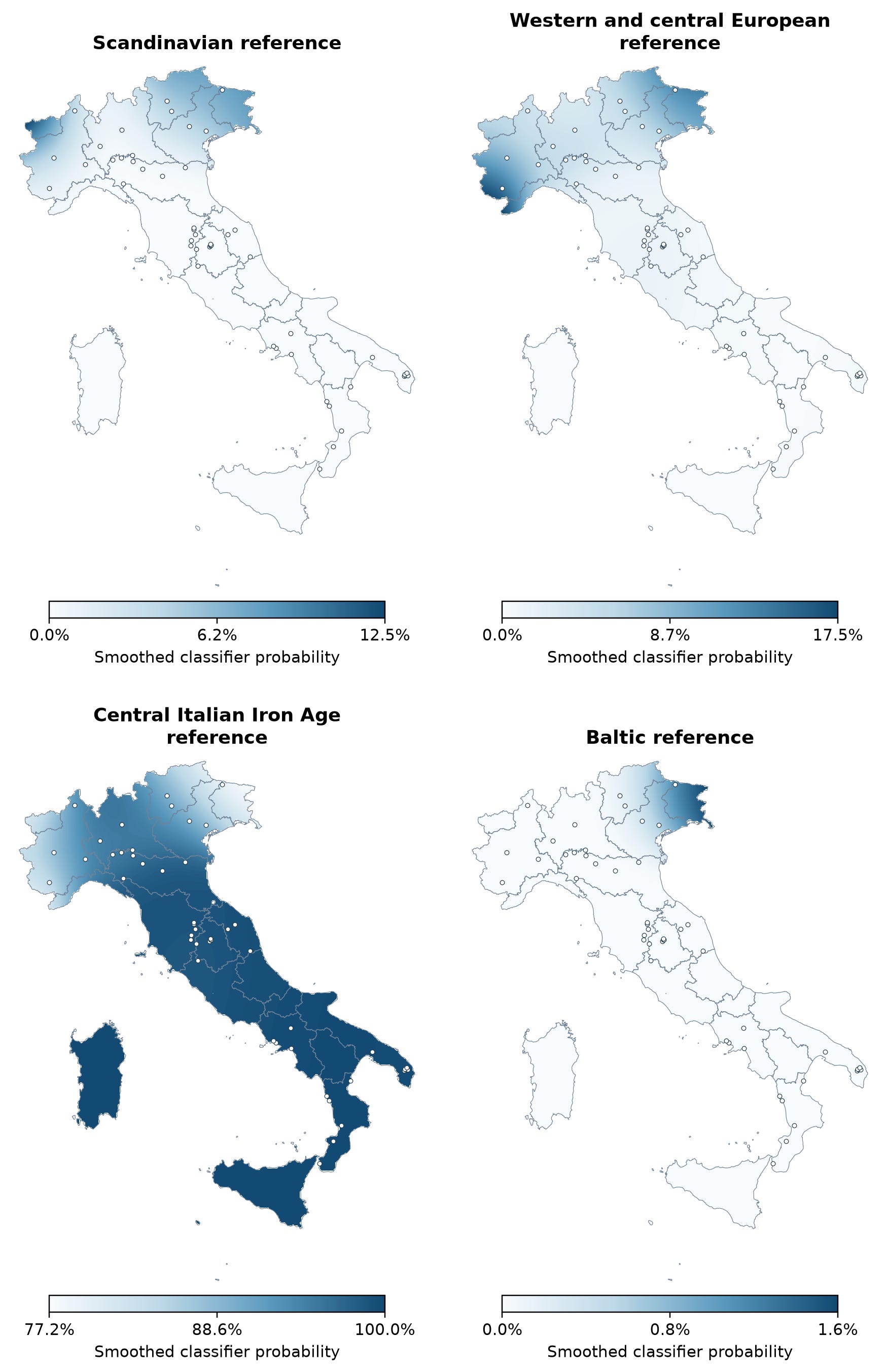
Open the interactive modern maps to search for an individual or area, change the smoothing width, or compare all panels on a shared 0–1 scale. Every one of the 403 modern genomes contributes, including those known only to region or province. The map spreads those broader locations across their reported area rather than assigning invented hometowns.
I find the contrast within northern Italy more interesting than a simple north–south gradient. The five people whose western/central probability exceeds 0.5 come from Cuneo in Piedmont, Piacenza in Emilia-Romagna, Sappada in Veneto, and the regional samples from Trentino-Alto Adige and Friuli-Venezia Giulia. The four high Scandinavian assignments have a different distribution: one in Valle d’Aosta, one in Trentino-Alto Adige and two in Friuli. The Celtic and Germanic proxies overlap geographically, as their histories would lead us to expect, while retaining distinct western and Alpine or northeastern concentrations.
Lombardy is comparatively pale on both of those maps. All 21 Lombardy individuals, including the Bergamo samples, favour the Italian reference above 0.5. That is worth spelling out because the historical name Lombardy might otherwise tempt us to expect a uniformly strong Germanic signal there. The modern pattern instead points to considerable local variation, and the ancient Collegno result lies across the regional boundary in Piedmont. I also have only two people from Valle d’Aosta, so its dark Scandinavian patch rests heavily on one individual.
Further south, the western/central and Scandinavian surfaces fade across Tuscany and the rest of central Italy, while southern Italy and Sicily sit very close to zero on those two scales. Sardinia has the strongest and most uniform preference for the Italian comparator. I would therefore describe the geographical result as several northern concentrations against a much broader Italian background. I can see those concentrations in the sampled genomes; the uneven coverage of regions still limits how confidently I can draw their boundaries.
Of the 403 modern people, 394 have probability above 0.5 for the Italian reference, five for the western/central reference and four for the Scandinavian reference. All nine of the latter individuals are northern Italians. None exceeds 0.5 for the Baltic reference. Individual 74.ALP73 from Cuneo, for example, receives 99.7% support for the western/central class. The classifier is recognising a strong relative affinity in this person. The modern sample is unevenly distributed, so these counts should be read as a description of the people included.
Upgrade to paid to see my original analysis of when Celtic and Germanic genetic signals appear in Italy, how closely they match recorded migrations, and which connections were already present in the Bronze Age. Then discover why two Baltic-like soldiers were buried in Sicily in 480 BCE.
